What Is a Technical SEO Expert? What They Do and When to Hire One
Understand the role, responsibilities, services and hiring criteria of a Technical SEO specialist.
Read the article →Conduct a technical SEO audit by defining the website’s priority pages, reviewing crawlability, indexability, architecture, rendering and performance, then ranking findings by business value, severity, scale, effort and implementation risk.

Prefer a short overview? Watch Technical SEO Audits, Fixes & Implementation for the evidence-to-validation workflow in under a minute.
For broader examples, review common Technical SEO issues before prioritizing fixes.
A technical SEO audit tool can produce hundreds of warnings before you have finished your first coffee. The more difficult part is determining which warnings represent genuine search problems, which affect valuable pages, and which can safely remain near the bottom of the list.
A useful technical SEO audit is therefore not a race toward a perfect site-health score . It is a structured investigation into whether search engines can discover, access, render, understand and index the pages that matter to the business.
The process should begin with audit scope and business priorities. It should then examine crawlability, indexability, canonical signals, architecture, rendering, performance and structured data. Finally, each finding should be prioritized, implemented and validated against the original technical condition.
A technical SEO audit is a systematic review of the website conditions that influence how search engines access, process and interpret pages.
It normally examines:
A technical audit is not the same as a complete SEO audit. Keyword targeting, content quality, backlinks, conversion design and competitor analysis may be important, but they represent different workstreams.
For a role-level view of what a Technical SEO specialist checks , use the specialist responsibilities guide alongside this checklist.
The audit should also be more than an automated export. Audit tools identify detectable conditions; they do not automatically know whether a URL is commercially important, whether it should be indexed, or whether changing it introduces additional risk.
Begin by defining what the website needs from the audit. For a focused next step, review post-migration SEO audit.
Identify its most important pages and templates, including:
Record any known context that could influence the findings:
You should also establish a baseline. Record current indexing patterns, important HTTP responses, Core Web Vitals data, organic performance and representative URL examples before changes begin.
This context prevents every warning from being treated equally. A minor issue on an old, low-value URL is not automatically as urgent as an unintended
noindex
directive applied to a primary service template.
A practical audit should cover the full path from discovery to validation rather than treating isolated tool warnings as separate projects.
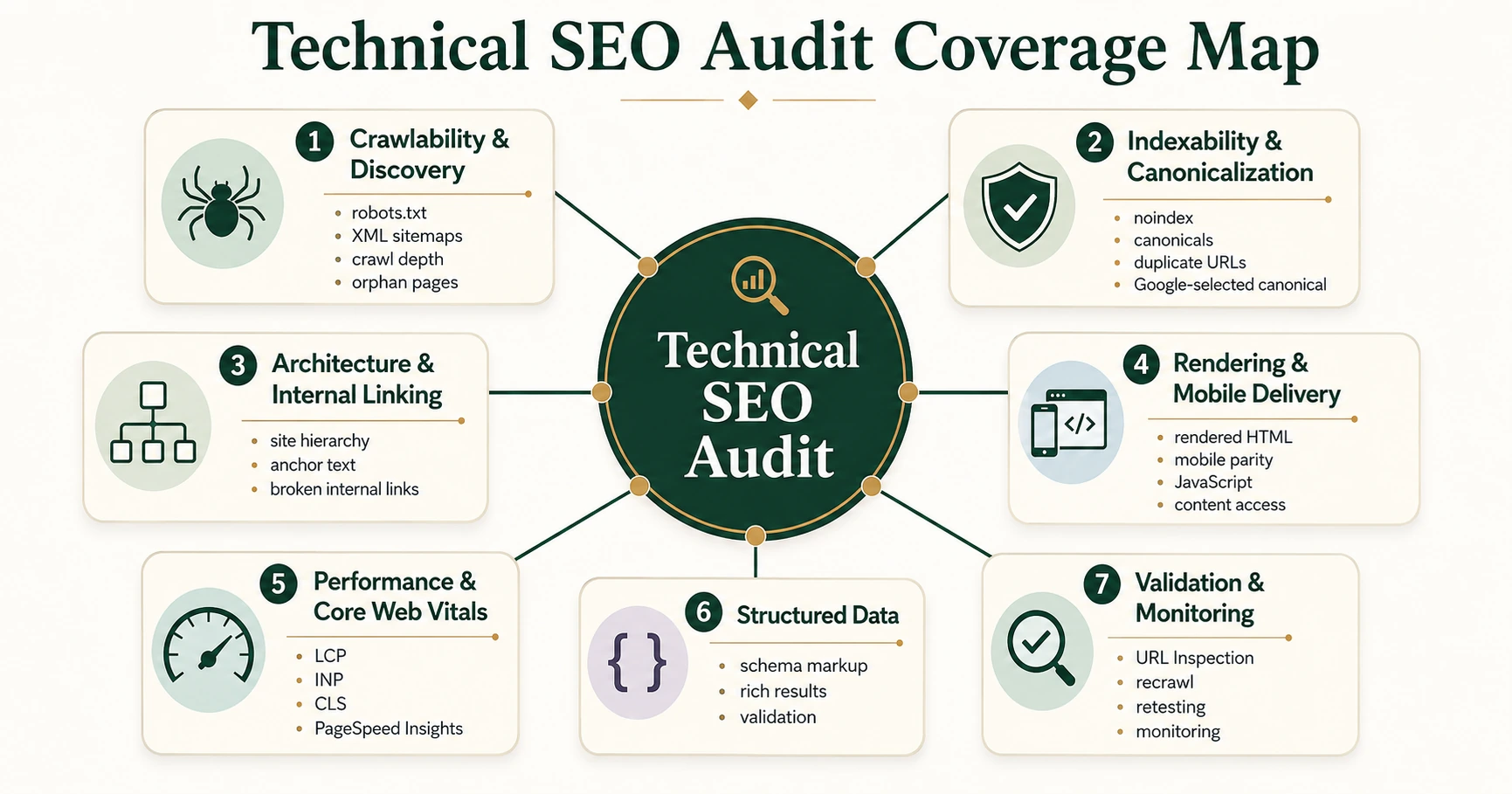
First, determine whether search engines can find and request the URLs that matter. For a focused next step, review website crawlability audit.
Review:
robots.txt
rules
Important live pages should normally return a successful
200 OK
response. Redirecting, missing or server-error URLs should be investigated according to their intended purpose rather than automatically classified as mistakes.
An XML sitemap can help search engines discover preferred URLs, but sitemap inclusion does not override a crawl block,
noindex
directive, redirect or conflicting canonical.
A crawlable page is not necessarily indexable. For a focused next step, review website indexability audit.
Review whether important pages:
noindex
directives
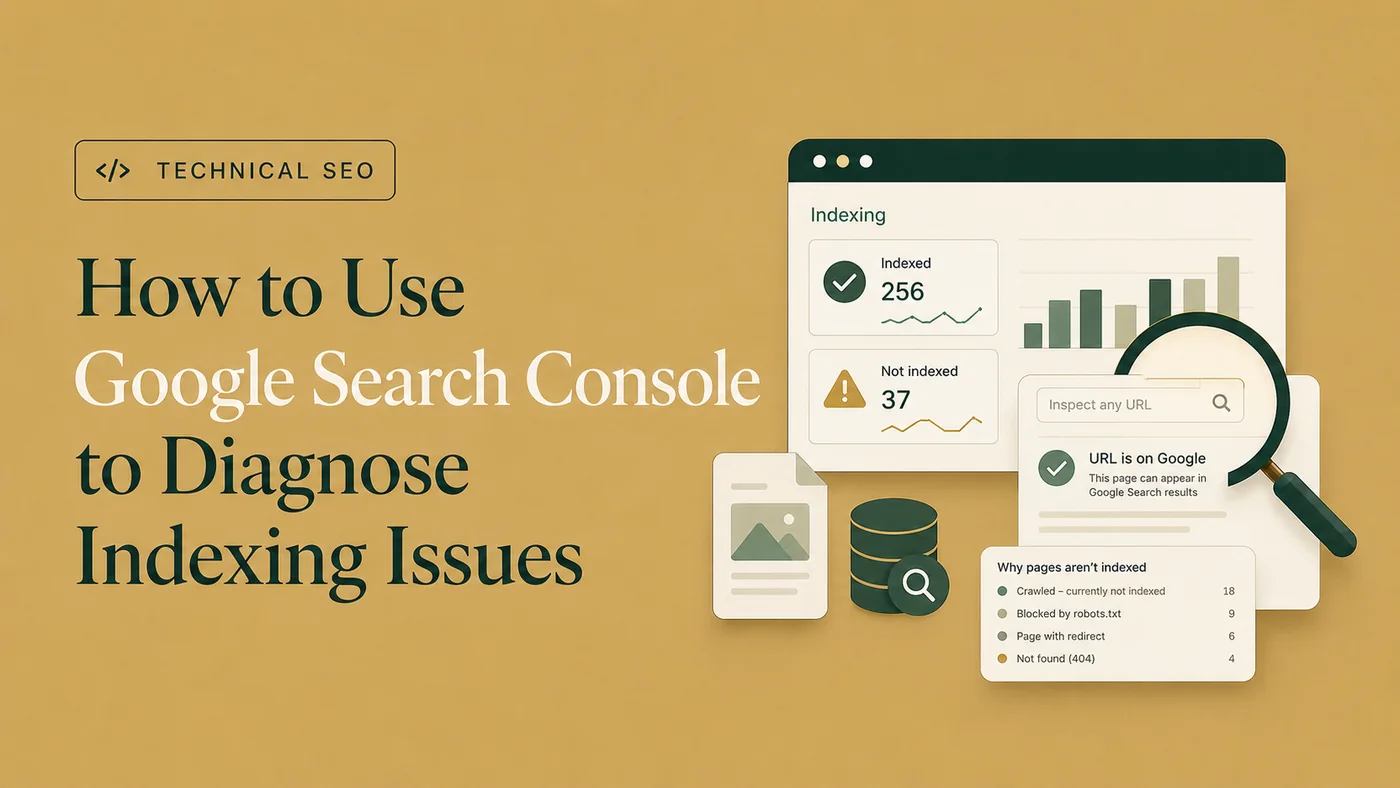
Use URL Inspection for representative high-value URLs rather than inspecting every low-value URL individually. The Page Indexing report can reveal broader patterns, while URL Inspection provides page-level evidence.
For a more detailed process, use the Page Indexing report and URL Inspection together to diagnose indexing issues in Google Search Console .
Canonical tags should also be evaluated alongside redirects, internal links and sitemap entries. A technically valid canonical can still be unhelpful when the surrounding signals point elsewhere. The dedicated guide to canonical tag best practices covers this subject in greater depth.
Site architecture should help users and search engines reach important content through logical, crawlable paths. For a focused next step, review internal linking audit.
Check for:
There is no universal rule requiring every page to sit a fixed number of clicks from the homepage. The practical question is whether high-value pages are easy to reach from relevant sections of the site.
A page without internal links exists, but the rest of the website behaves as though it has never been introduced.
Modern websites may load important content, links or structured data through JavaScript. Compare the raw source with the rendered HTML where rendering problems are suspected. For a focused next step, review Core Web Vitals audit.
Confirm that:
Review Core Web Vitals using field data where available and lab testing for diagnosis. The key metrics are Largest Contentful Paint, Interaction to Next Paint and Cumulative Layout Shift.
Performance findings should be interpreted in context. A lab warning may identify a genuine optimization opportunity, but it does not by itself explain every ranking or traffic problem.
Check whether relevant structured data: For a focused next step, review schema markup audit. For a focused next step, review schema markup implementation.
Use the Rich Results Test for Google-supported rich-result eligibility and a general schema validator where broader Schema.org validation is needed.
Valid structured data can make a page eligible for supported search features, but it does not guarantee that a rich result will appear.
When the audit identifies a specific condition, use a more detailed diagnostic workflow to find and fix technical SEO issues rather than trying to solve every implementation problem inside the checklist.
Get a focused SEO review that identifies the issues, missed opportunities, and priority fixes. For a focused next step, review professional Technical SEO audit.
A practical minimum toolset includes:
Use the Page Indexing report, URL Inspection, Core Web Vitals reports, enhancement reports and search-performance data.
Use a crawler to review status codes, redirects, internal links, canonicals, directives, crawl depth, duplicate elements and sitemap URLs at scale.
Use PageSpeed Insights to examine field and lab performance data and identify likely causes of Core Web Vitals problems.
Use the Rich Results Test to validate structured data supported by Google Search.
Use browser tools to inspect rendered HTML, network requests, console errors, mobile behaviour and resource loading where necessary.
Additional tools may be needed for server-log analysis, enterprise crawling, JavaScript debugging, rank tracking or backlink analysis. They are not mandatory for every website.
Rank each finding against six factors:
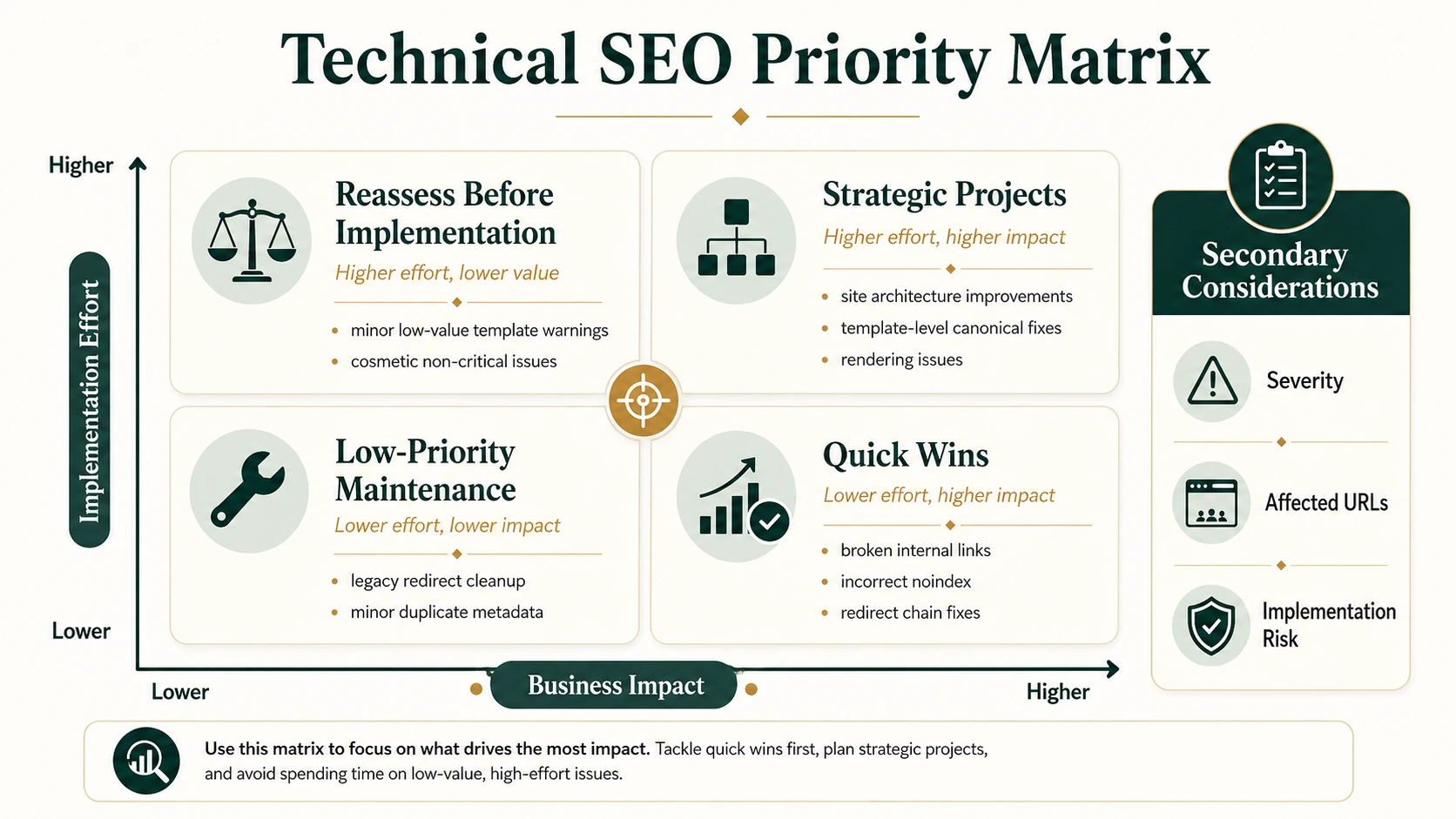
Critical findings usually include conditions such as site-wide
noindex
directives, server failures, redirect loops, blocked commercial sections or incorrect canonicals applied across important templates.
Lower-priority findings may include warnings on URLs that should not be indexed, minor inconsistencies on obsolete pages or recommendations with no plausible effect on users or search access.
Given enough URLs, most audit tools will eventually find something to be unhappy about. The goal is not to keep the tool cheerful. The goal is to protect and improve the pages that contribute to the website’s objectives.
When a website has extensive, conflicting or template-level findings, Technical SEO audit and implementation support can help convert the evidence into a prioritized roadmap and validate the completed changes.
Validation is part of the implementation , not an optional final decoration.
After a change:
A fix is technically successful when the original condition changes as intended. A broken internal link should point to a working destination. An unintended
noindex
should be removed. A redirect chain should reach the final page directly. A canonical should identify the intended preferred URL.
Technical validation does not guarantee an immediate ranking or traffic improvement. Search performance also depends on relevance, content quality, competition, authority, demand and how search systems evaluate the page.
A technical SEO audit normally covers crawlability, indexability, response codes, redirects, canonicalization, XML sitemaps, site architecture, internal links, rendering, mobile delivery, Core Web Vitals, HTTPS, structured data, prioritization and post-fix validation.
The minimum practical toolset includes Google Search Console, a website crawler, PageSpeed Insights, the Rich Results Test and browser developer tools. Larger or more complex websites may also require server-log analysis and specialist rendering tools.
No. An automated score summarizes detectable conditions but cannot reliably determine the business importance of affected pages, the likely impact of each warning or the implementation risk. Findings still require manual interpretation and prioritization.
The appropriate frequency depends on the website’s size, publishing activity, platform and rate of change. An audit is particularly useful before and after migrations, redesigns, major template changes, CMS updates or unexplained changes in organic performance.
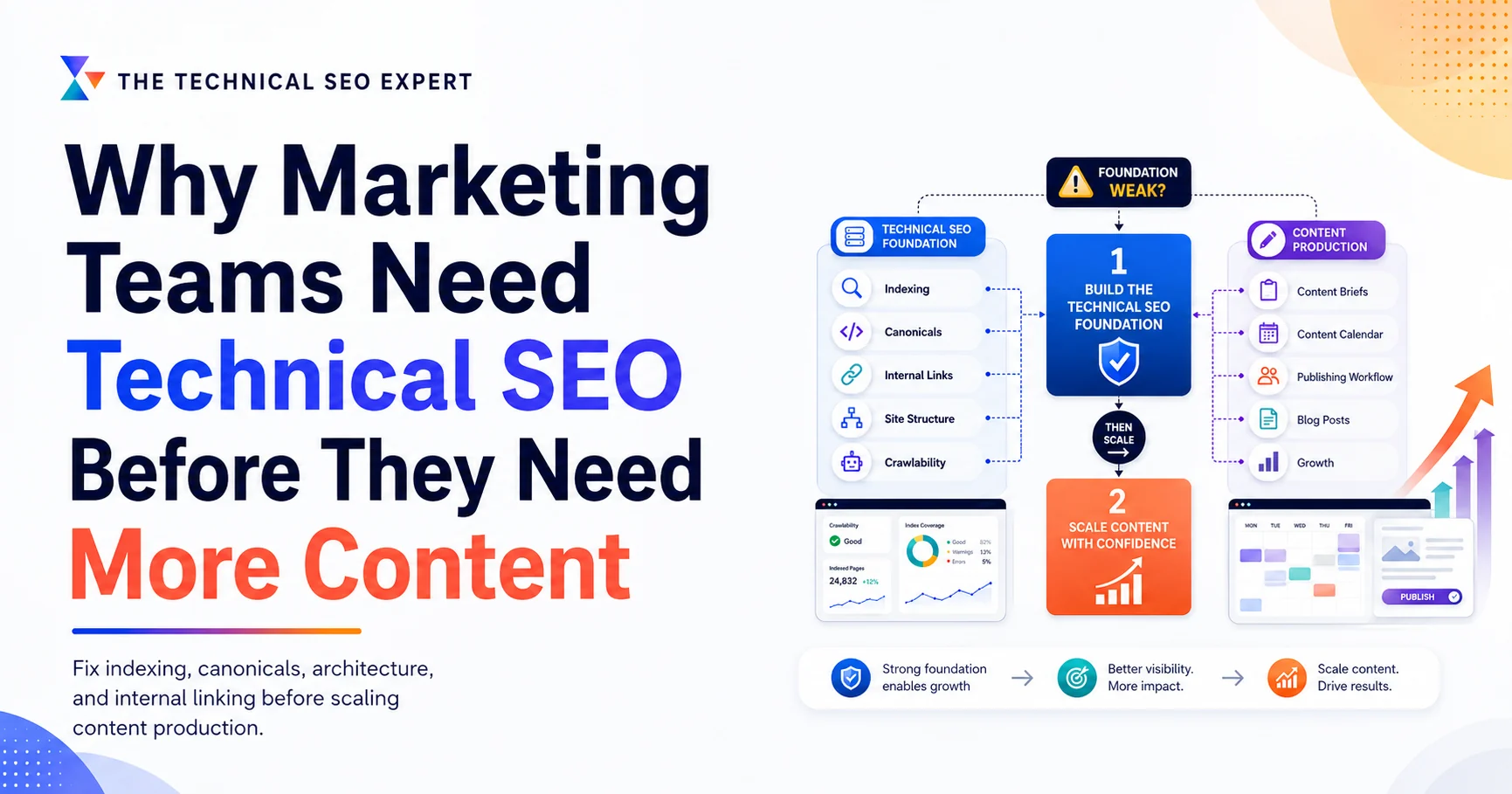
For marketing teams deciding whether to audit first or publish more, the guide on Technical SEO vs content marketing priority explains how to identify the real growth constraint.
A practical technical SEO audit should answer three questions:
Begin with business-critical pages and important templates. Review crawlability, indexability, canonical signals, architecture, rendering, performance and structured data. Then prioritize the findings, implement the appropriate changes and validate the original condition again.
The website does not need a perfect audit score. Its important pages do need to be accessible, indexable, logically connected and supported by consistent technical signals .

Clear diagnosis, practical fixes, and excellent communication.
Verified Upwork feedback