How to Find and Fix Technical SEO Issues on Your Website
Use the parent workflow to identify crawl, indexing, internal-linking, and implementation issues.
Read the article →Fix indexing, canonicals, architecture, and internal linking before scaling content production.
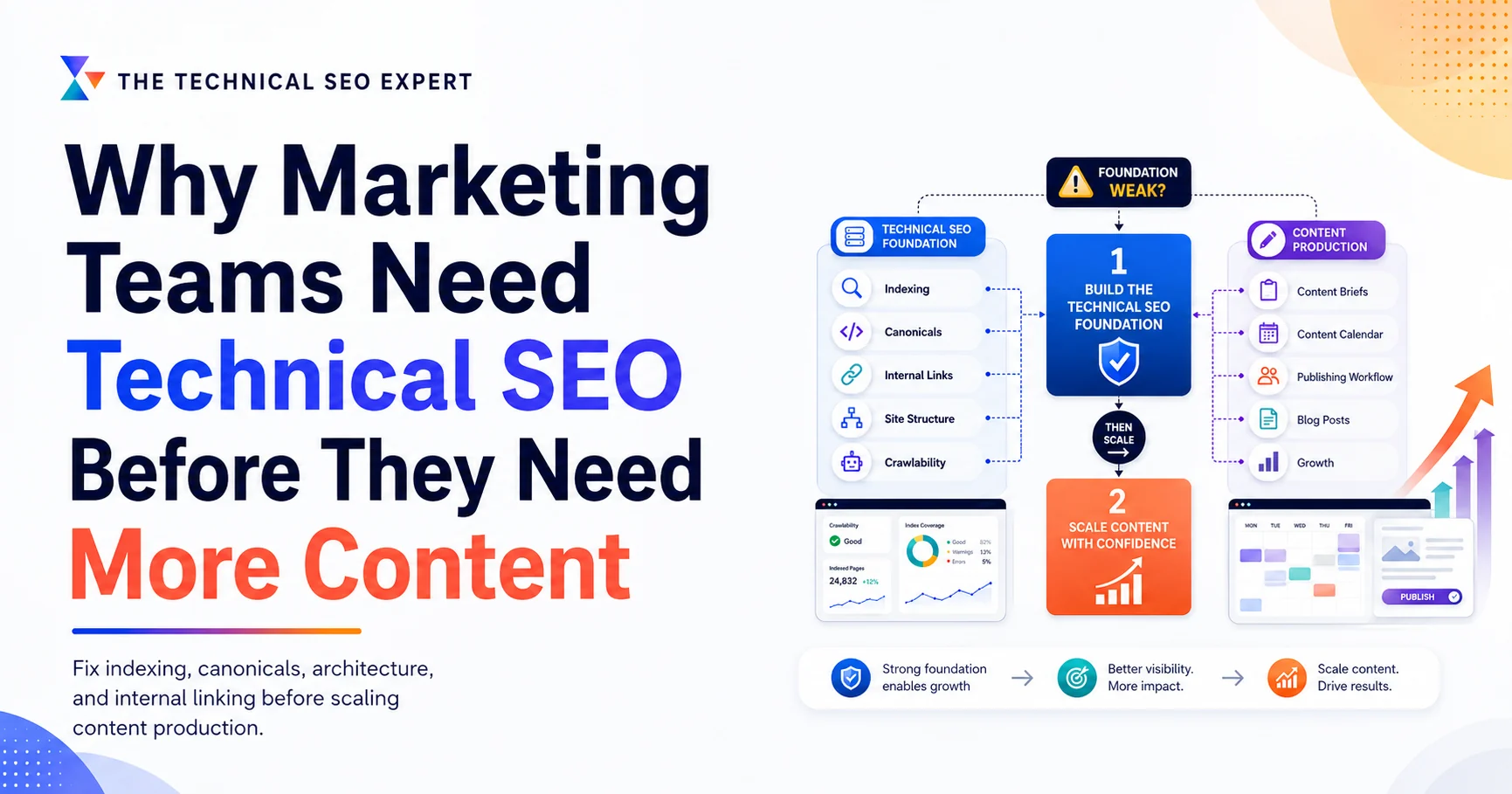
Marketing teams should prioritize Technical SEO before increasing content production when existing pages are difficult to discover, crawl, index, consolidate, render, or support through internal links. Once those foundations are healthy, additional content can become the stronger growth lever.
When organic growth slows, the default marketing response is often straightforward: publish more.
More articles. More landing pages. More keyword targets. More briefs added to the content calendar.
Sometimes that is exactly the right answer.
But if the content you already have is not being discovered, indexed, consolidated correctly, or supported by the site architecture, publishing more pages can simply increase the number of URLs experiencing the same problem.
The real question is not Technical SEO vs content marketing as though one discipline has to defeat the other. It is:
What is currently constraining organic growth?
If the constraint is content coverage, produce better content. If the constraint is technical, structural, or indexation-related, fix the foundation before scaling production.
If you already know the site has technical problems, the broader guide on how to identify and fix Technical SEO issues explains the diagnosis and remediation process. This article focuses on the marketing decision: what deserves budget and attention first?
Neither Technical SEO nor content marketing automatically comes first in every situation.
The right priority depends on the website's current bottleneck.
| Situation | Priority |
|---|---|
| Valuable search topics are not covered | Content |
| Important existing pages are not indexed | Technical SEO |
| Existing pages target the wrong search intent | Content |
| Canonical tags point to the wrong URLs | Technical SEO |
| Site architecture is healthy but topical coverage is limited | Content |
| Hundreds of pages overlap around the same intent | Technical SEO + consolidation |
| Important pages have weak or missing internal links | Technical SEO / site architecture |
| Existing pages rank but provide incomplete answers | Content |
| A migration or redesign introduced redirect and indexing problems | Technical SEO |
| Existing content performs well and new demand is clearly identified | Content |
This distinction matters because content and Technical SEO solve different problems.
Content helps answer more useful questions, cover more relevant demand, and provide stronger information.
Technical SEO helps ensure search engines can reliably find, process, index, consolidate, and understand the pages carrying that information.
A technically healthy site with insufficient content needs content.
A large content library with broken indexing and architecture does not necessarily need another publishing sprint.
New content cannot compensate for a technical instruction that prevents the page from entering Google's index.
Publishing five new articles does not fix an accidental sitewide
noindex
.
Another content brief does not change a canonical tag pointing valuable pages to the wrong URL .
Increasing publishing frequency does not repair redirect chains, orphan pages, broken internal links, duplicate URL patterns, or important content hidden behind uncrawlable navigation.
Google's technical requirements make the fundamental distinction clear: a page needs to be accessible to Google, return a successful response, and contain indexable content before it can be eligible for Search. Crawling and indexing are separate from the question of whether the content itself is competitive enough to rank.
More content is therefore not a universal SEO growth strategy.
It is one possible investment after you understand what is holding existing organic performance back.
Before creating new pages, determine whether Google is indexing the pages that already matter.
Check:
If these pages are missing from Google's index, investigate why.
Possible causes include:
An XML sitemap can help Google discover URLs, but sitemap inclusion does not force indexing.
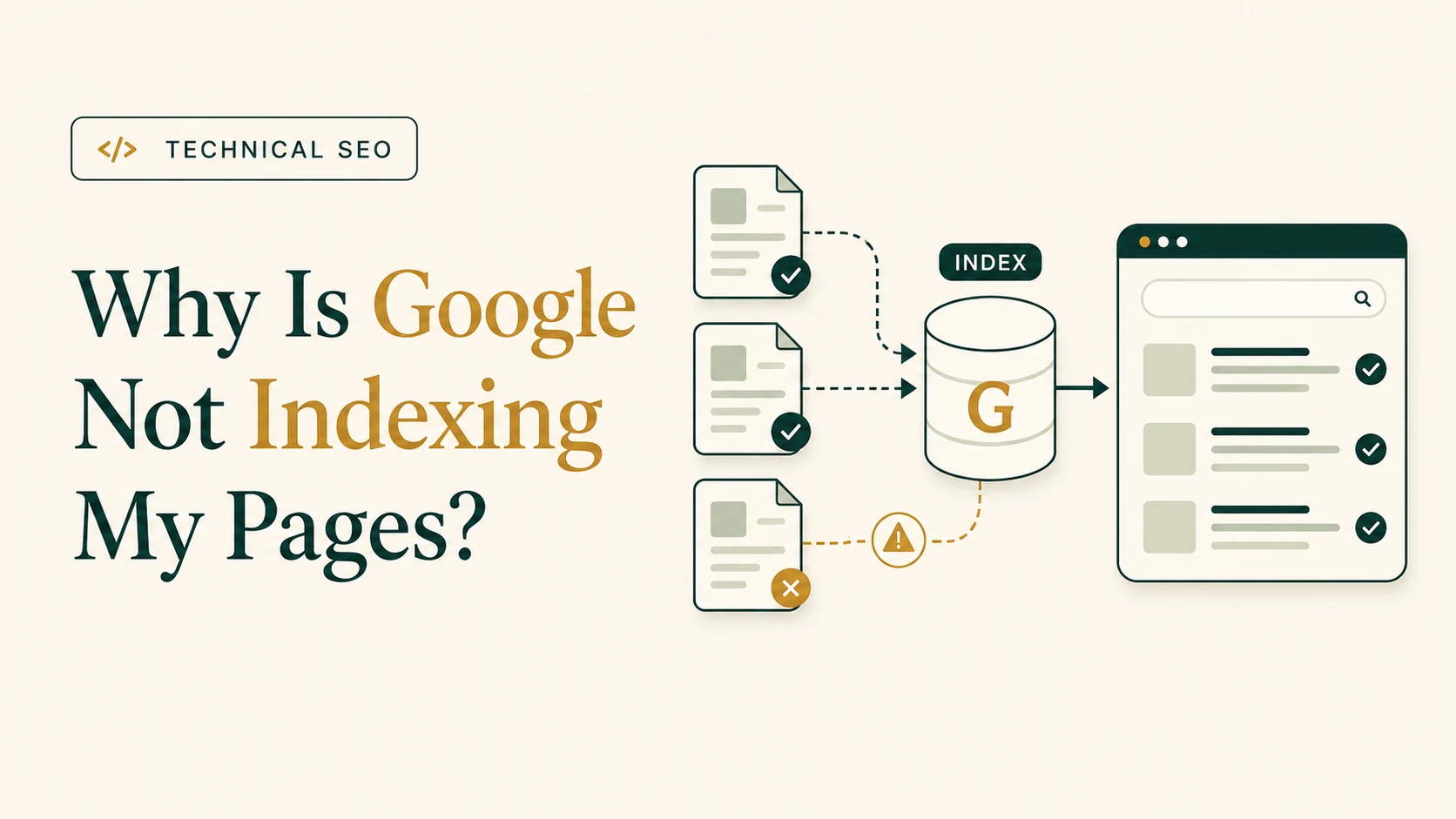
If important pages are consistently excluded, use a structured workflow to understand why Google is not indexing important pages before increasing publishing volume.
Content teams usually think in topics and pages.
Search engines also have to deal with URLs.
One article may accidentally exist through several URL variants. Internal links may point to one version, the sitemap may list another, and the canonical tag may declare a third.
Common conflicts include:
Google uses several signals when selecting a representative canonical URL, including redirects, canonical annotations, sitemap inclusion, and other page signals. Consistency makes the preferred URL clearer.
Publishing more content while these signals remain inconsistent can create more duplicate or competing URLs rather than more useful search visibility.
Content production tends to be additive.
A marketing team publishes a guide. Then another related guide. Then an industry version. Then a “2025 update.” Then a new writer creates another page because nobody realized three similar URLs already existed.
Eventually, the question is no longer “Do we need more content?”
It becomes:
Do we understand the content we already have?
Look for:
Internal links help Google discover pages and understand relationships between them. If the site's own architecture does not clearly indicate which pages matter, increasing the number of pages may make the structure less clear rather than stronger.
More keyword targets do not necessarily require more URLs.
Consider these potential articles:
These might represent five useful pages.
Or they might represent one strong page and four overlapping ones.
The decision depends on search intent, scope, and whether each URL can genuinely answer a distinct task.
When several pages substantially overlap, you may see:
This is where query ownership becomes important.
Before commissioning another related article, ask:
Which existing URL should own this intent?
Sometimes the correct content strategy is a new page.
Sometimes it is improving an existing one.
Sometimes it is merging two weaker pages into one better resource.
This is a diagnostic signal—not proof of a Technical SEO problem.
If your publishing volume has doubled while impressions, clicks, indexed landing pages, and conversions remain relatively flat, investigate what is happening before doubling output again.
Review:
A flat growth curve may still be caused by content quality, weak authority, poor query targeting, or competition.
The point is to diagnose the constraint rather than assuming publishing volume is the answer.
Often, yes—but not automatically.
Existing pages may already have:
Improving one established page can sometimes be more useful than publishing a new URL targeting almost the same problem.
Consider updating existing content when:
Create a new page when the search intent is genuinely different and deserves independent treatment.
The principle is simple:
Use a new URL because a new page is necessary—not because the content calendar has an empty slot.
More content is the right investment when the technical foundation is reasonably healthy and a genuine coverage gap exists.
That usually means:
For example, if your Technical SEO foundation is clean and customers repeatedly search for a problem your site has never addressed, content creation makes sense.
If you already have five weak pages addressing that same problem, number six is less likely to be the answer.
A useful decision process has four stages.
Before planning another quarter of production, understand the current inventory.
For each important page, collect where practical:
Then classify pages into groups:
This reveals whether your biggest opportunity is expansion or cleanup.
Review whether the existing site reliably supports organic search.
A focused Technical SEO audit should examine areas such as:
The objective is not to achieve a perfect audit score.
The objective is to identify technical conditions capable of limiting valuable pages.
Classify the main limitation.
Technical constraint: Pages cannot reliably be crawled, indexed, consolidated, rendered, or reached through the site's architecture.
Content constraint: The site lacks relevant topics, answers search intent poorly, or has outdated and incomplete information.
Authority constraint: The site has appropriate technical foundations and useful content but lacks sufficient external trust or competitive authority.
Demand constraint: The organization is producing more pages than meaningful search demand justifies.
Mixed constraint: Several of the above are happening simultaneously.
Most real sites fall into the mixed category.
The goal is to identify which constraint should receive attention first.
The outcome might be:
This is a better budget decision than automatically increasing output because traffic growth slowed.
A clean technical foundation does not make weak content rank.
A
200
status code is not expertise.
A self-referencing canonical is not a compelling answer.
Excellent Core Web Vitals do not create search demand where none exists.
Technical SEO removes or reduces technical barriers. Content still has to:
The relationship is complementary.
Technical SEO helps ensure the content can participate effectively in Search. Content gives search engines and users something valuable to evaluate.
Imagine a marketing team publishes eight articles per month.
After a year, the site has:
Increasing production may create more inventory, but the existing evidence suggests the team first needs to understand why so much of the current inventory is underperforming.
A better sequence would be:
That is not “choosing Technical SEO instead of content.”
It is making content investment more efficient.
Not universally. Technical SEO should be prioritized when technical barriers are preventing valuable content from being crawled, indexed, consolidated, rendered, or internally supported. When the technical foundation is healthy, content may be the stronger growth priority.
Usually not until you understand why important pages are not being indexed. Publishing additional pages can increase the number of affected URLs without fixing the underlying cause.
Not always. Critical technical issues may justify pausing affected production, but marketing and Technical SEO work can often proceed in parallel. The important point is not to scale a broken pattern.
Publishing volume itself is not automatically harmful. Problems arise when increased production creates overlapping, thin, poorly linked, low-value, or technically inconsistent pages.
Consider an audit when important pages are missing from Google, indexing exclusions are widespread, canonical signals conflict, organic visibility changed after a redesign or migration, or the site has accumulated a large and poorly understood URL inventory.
More content makes sense when important existing pages are technically healthy, the new topic represents a genuine content gap, search intent is distinct, and the page has a defined role within the site's architecture and customer journey.
Marketing teams should not treat content volume as the default answer to weak organic growth.
Before increasing production, understand what the existing website is telling you.
Are important pages indexed? Are canonical signals consistent? Does the architecture support the pages that matter? Are similar articles competing with each other? Are content teams publishing into a structure that search engines and users can actually navigate?
If those foundations are weak, Technical SEO should come first—or at least become part of the same priority cycle.
If those foundations are healthy and valuable search demand remains uncovered, publish more content.
The strategic question is not Technical SEO or content marketing?
It is:
Which constraint is preventing organic growth right now, and which investment will remove it?
For teams that need help separating technical constraints from content problems, Technical SEO audit and implementation support can provide the evidence, prioritization, implementation requirements, and validation needed before the next content-production decision.

I work on Technical SEO audits, Google Search Console indexing problems, crawlability, site architecture, structured data, and implementation support for websites that need clean diagnosis and practical fixes.
About Murat →

Clear diagnosis, prioritized fixes, and practical implementation support.
Verified Upwork feedback