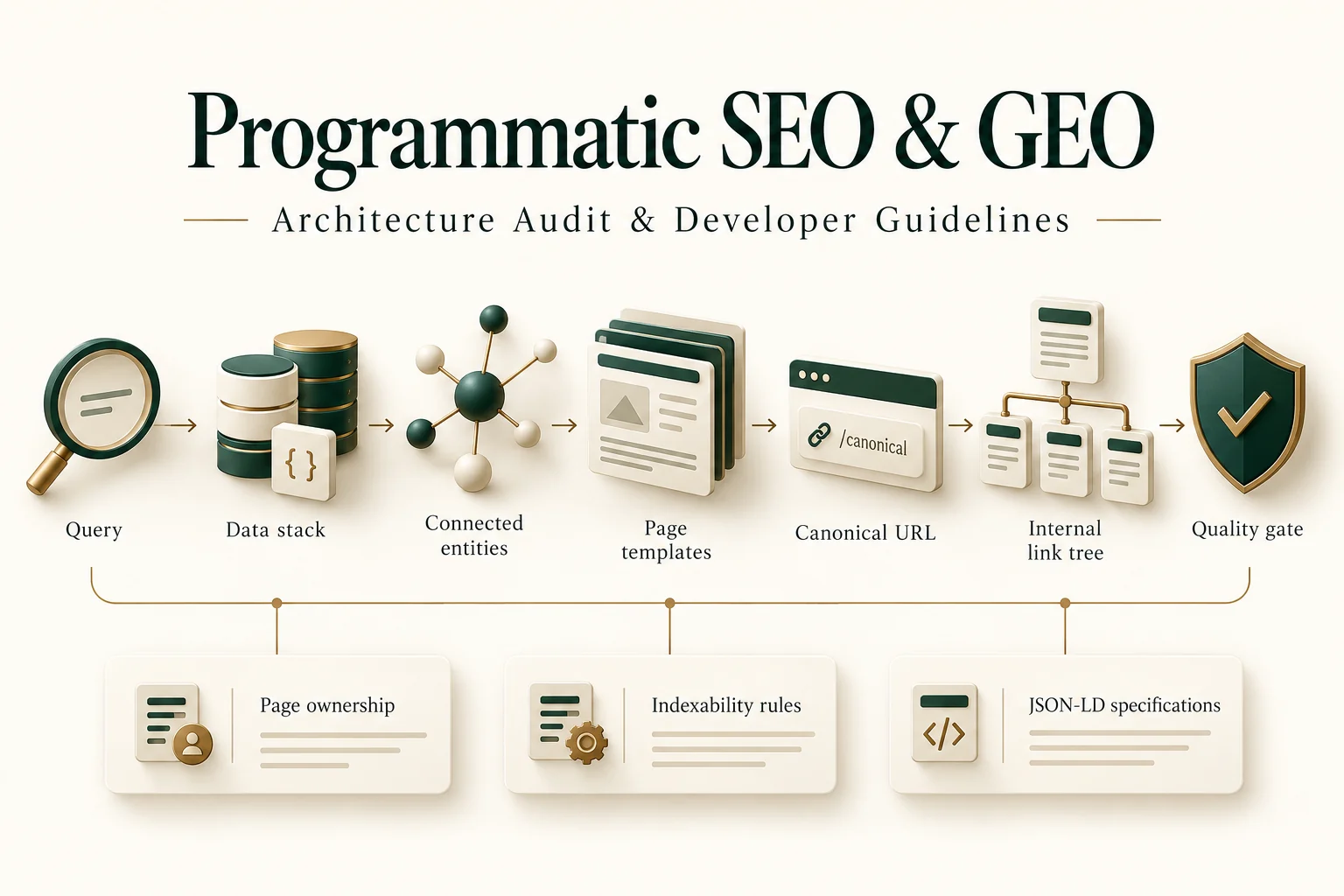
Plan the rules behind your data-driven pages before expanding the inventory. I audit Programmatic SEO architecture and translate the findings into page-family responsibilities, template requirements, indexability controls, internal linking rules and developer-ready SEO specifications. GEO requirements add clarity around entities, facts and evidence to the same system.
Who this service is for
This service suits product and engineering teams working on sports data platforms, marketplaces, directories, SaaS comparison sites and large ecommerce inventories. It is useful before a new template launch, when URL generation has outpaced quality control, or when overlapping page families make ownership unclear.
You do not need a fixed minimum number of pages. The relevant question is whether the same decisions must be applied across a growing set of pages. If your problem is confined to a few existing URLs, a focused technical SEO or indexing audit may be sufficient.
Query ownership and page family design
I review the search tasks your platform can support and map them to page types. This separates valid landing-page opportunities from filters or combinations that add little independent value. The architecture defines which hub, category, entity, comparison or leaf page should own each task.
The resulting map gives developers a decision framework for title and H1 logic, page relationships and new URL proposals. It also helps identify where existing pages should be consolidated rather than expanded.
Data and template contracts
Each page family needs a clear agreement between data and rendering. I specify mandatory fields, source and update requirements, conditional modules, missing-data behaviour and the information that makes one page useful in its own right.
Templates may share layout, but they should not publish empty comparisons or unsupported answers. The specification identifies which requirements belong in the data pipeline and which belong in the rendered page.
URL crawl and indexing controls
The audit covers preferred URL patterns, canonical logic, parameter and filter handling, crawlable navigation and XML sitemap eligibility. I distinguish publication, discovery and indexing rather than applying one rule to every generated URL.
Quality gates can incorporate completeness, distinct value, freshness, HTTP status, canonical consistency and internal-link support. The appropriate thresholds depend on the page family; there is no universal word count or similarity score that makes every page eligible.
Internal linking and structured data
I define hub-to-leaf, breadcrumb and contextual linking requirements that developers can implement from reliable relationships. The schema specification maps valid page types and entity references to visible content, with JSON-LD examples and validation expectations.
For an isolated structured-data repair, see the schema markup service. This architecture service coordinates those rules with the larger page system.
GEO and AI search readiness
GEO work within this service focuses on clear entities, attributable facts, useful answers and consistency between visible content and structured data. It does not create a second inventory of pages for every AI query variation.
Google's AI search guidance retains the core SEO requirements. AI citation, indexing and ranking outcomes are not guaranteed by a template, a schema type or an audit. For a broader AI content and visibility engagement, see AI Search Optimization.
What you receive
- A page-family and query-ownership map.
- A prioritized architecture audit with affected templates and implementation decisions.
- Template contracts covering required data, conditional modules and failure behaviour.
- URL, canonical, crawl, sitemap and indexability specifications.
- Internal linking rules and JSON-LD examples where applicable.
- Rollout cohorts, acceptance criteria and a QA checklist.
Deliverables are scoped to your platform. The 1,075-row matrix in the sports-platform case study is an example from that project, not a promised size for every engagement.
How the engagement works
First, we confirm your platform, goals, page families and implementation constraints. I then review the available URL inventory, rendered templates and relevant data. Read-only GSC access, crawl exports and anonymized data samples can help where available.
The audit is followed by specifications and a review with your implementation team. Deployment support and post-release validation can be agreed as part of the scope. Pricing and timing depend on template complexity, access and the required delivery; there is no published fixed turnaround for this service.
Real project evidence
The sports data platform case study documents page-family ownership, indexability, URL and crawl rules, schema and internal linking requirements, controlled rollout governance and a 1,075-row implementation matrix. Review the case study to see the documented scope and the limits of its performance evidence.
Discuss your Programmatic SEO project
Share your website, the page families you are expanding and where implementation is currently blocked. I will review the requirement and suggest a suitable audit and specification scope.
Related resources: Programmatic SEO and GEO architecture guide; Programmatic SEO indexing quality gates; Sports data platform case study.
Technical reference: Google guidance on AI features and your website.