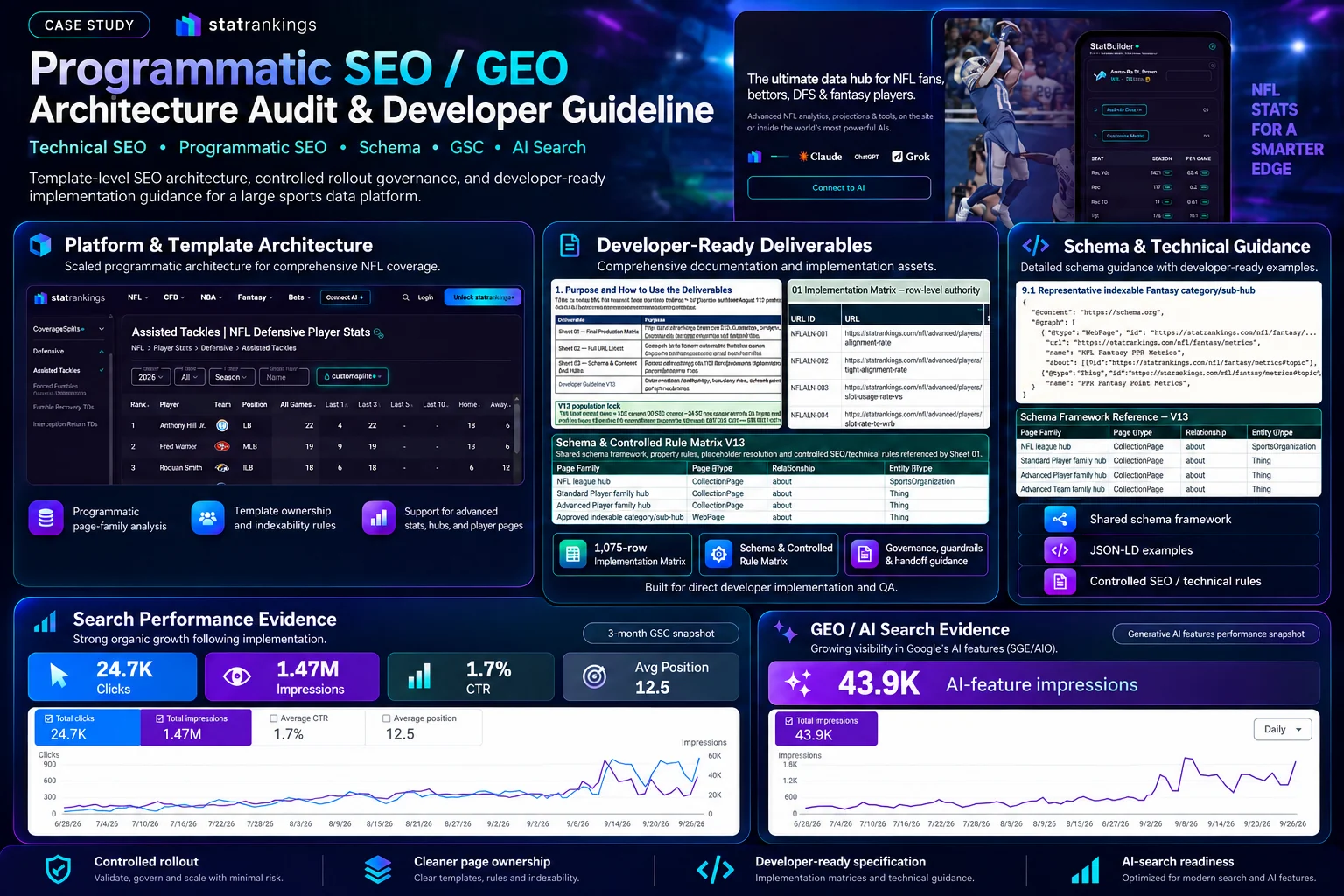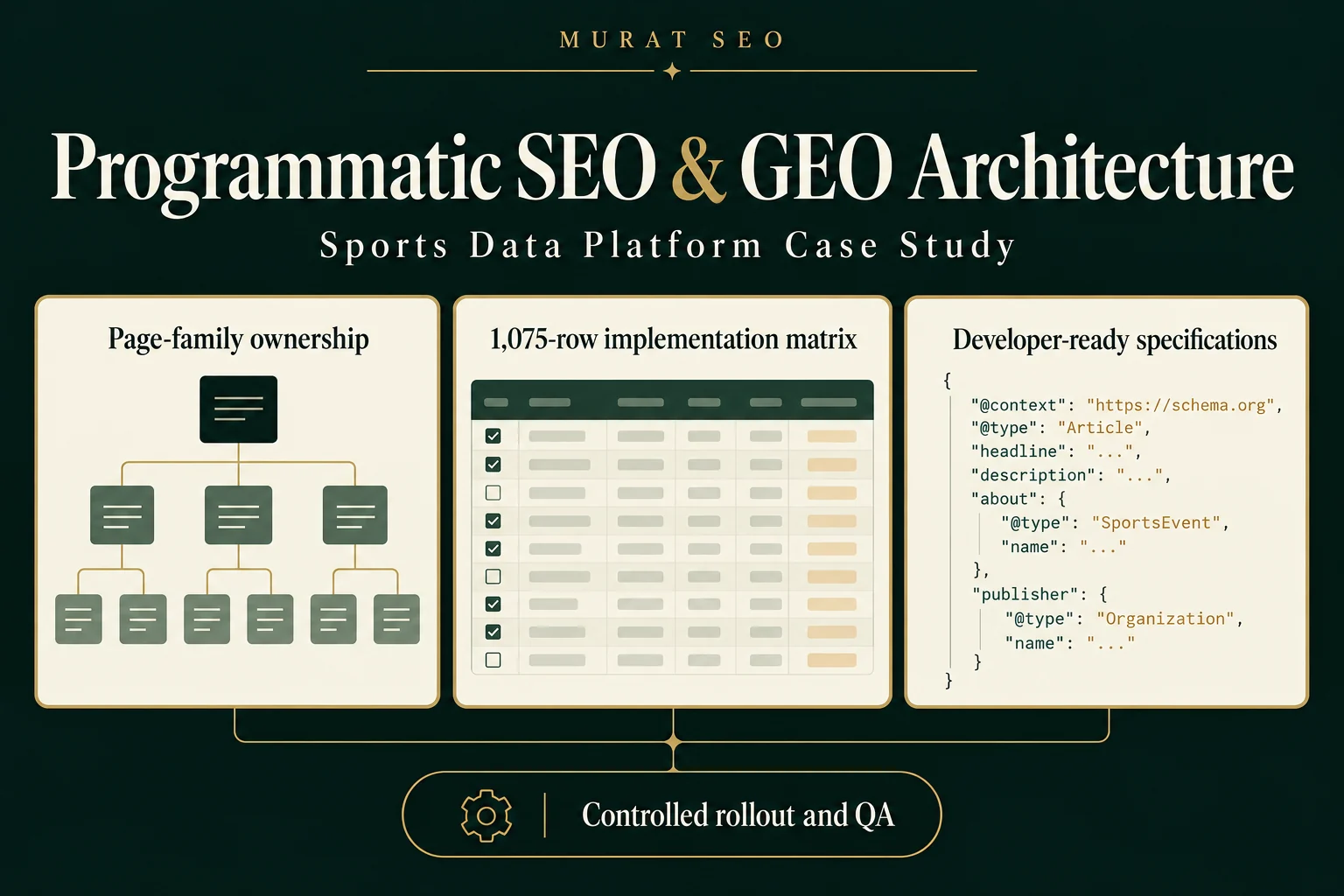
Led a template-level Programmatic SEO and GEO architecture project for a large sports data platform. I defined page-family ownership, indexability, URL and crawl rules, schema frameworks, internal linking requirements and controlled rollout governance. The handoff included a 1,075-row implementation matrix and developer-ready SEO and JSON-LD specifications for implementation and QA.
Project scope and my role
The portfolio identifies the platform as Statrankings. My role was Programmatic SEO and Technical SEO Specialist, with a focus on GEO and AI search readiness. The work covered the rules shared by families of data-driven pages rather than isolated title edits.
Sports platforms can serve overlapping queries through player, team, league, category and statistics pages. The architectural task was to make those responsibilities explicit: which page family owns an intent, which URL should be preferred, what information the template must contain and what controls apply before a new cohort is exposed to search.
Page family ownership before URL expansion
I defined page-family ownership and template requirements so implementation decisions could be made consistently across the inventory. The specification connected query intent, page type and supporting data to the intended URL owner.
This approach makes it possible to evaluate proposed pages before treating every data combination as a search landing page. It also gives developers a reference when adjacent hubs or leaf pages might serve the same task. See the architecture guide for the broader query-to-template framework.
Indexability URL rules and crawl controls
The architecture deliverables documented indexability, URL and crawl rules at template level. The handoff established the decisions developers needed to implement consistently, including how preferred pages should relate to URL variants and the crawlable inventory.
Indexing eligibility should be a deliberate decision. Producing a URL does not establish that its content is sufficiently useful, distinct or current to belong in search. The indexing quality-gate guide explains how to turn that decision into a repeatable control.
Schema and internal linking requirements
I delivered schema frameworks and JSON-LD specifications alongside internal linking requirements. These documents connected page types with the entities and relationships they describe, and clarified how hubs and relevant lower-level pages should support each other.
The purpose was consistent implementation: structured data should describe the visible page, while crawlable internal links should explain where that page belongs. Schema alone does not guarantee a rich result or an AI citation.
A developer handoff built for implementation and QA
The delivery comprised a 1,075-row implementation matrix plus developer-ready SEO and JSON-LD specifications. The matrix gave the implementation team a concrete inventory to work from, while controlled rollout governance provided a framework for implementing and checking changes in manageable groups.
- Page-family ownership and template responsibilities.
- Indexability, URL and crawl rules.
- Schema frameworks and JSON-LD implementation specifications.
- Internal linking requirements.
- Controlled rollout governance and QA guidance.
These are documented deliverables. The supplied materials do not establish that I personally deployed every change or that every row was implemented.
Search performance shown in the supplied portfolio
The supplied portfolio graphic displays a three-month snapshot with 24.7K clicks, 1.47M impressions, a 1.7% CTR and an average position of 12.5. Its separate panel is labelled 43.9K AI-feature impressions. These are figures visible in the supplied portfolio graphic, not a separately verified export or an attribution study.
The snapshot describes observed platform performance. It does not isolate the effect of the architecture work, establish an uplift against a baseline or prove citations across ChatGPT, Perplexity or other systems. The AI-feature panel retains the source's label; it should not be presented as a verified standalone Search Console AI report.
Evidence caption: Original supplied Upwork portfolio graphic. Displayed figures relate to its own snapshot; the surrounding page documents scope and deliverables, without attributing all platform performance to this project.
Evidence link: View the original Upwork portfolio entry
What another platform team can take from this project
At scale, the useful output of an architecture audit is a set of decisions developers can apply. Page ownership, indexing rules, internal links, entity relationships and rollout checks need to agree before expanding the inventory.
If your platform is preparing new templates or investigating a large indexation gap, start with the architecture audit service. For a narrower existing indexing problem, the Google Search Console indexing service may be the better first step.
Discuss your platform architecture
Share your platform URL, the page families you plan to expand and any known crawl or indexing constraints. I can review the scope and identify the appropriate architecture, implementation specification and QA work.
Related resources: Programmatic SEO and GEO architecture guide; Programmatic SEO indexing quality gates; Programmatic SEO and GEO architecture audit service.