Programmatic SEO & GEO Architecture: Data, Templates, Indexing and AI Search Visibility
Design query classes, data models, page templates, URLs, internal links and indexing controls for a scalable Programmatic SEO and GEO architecture.
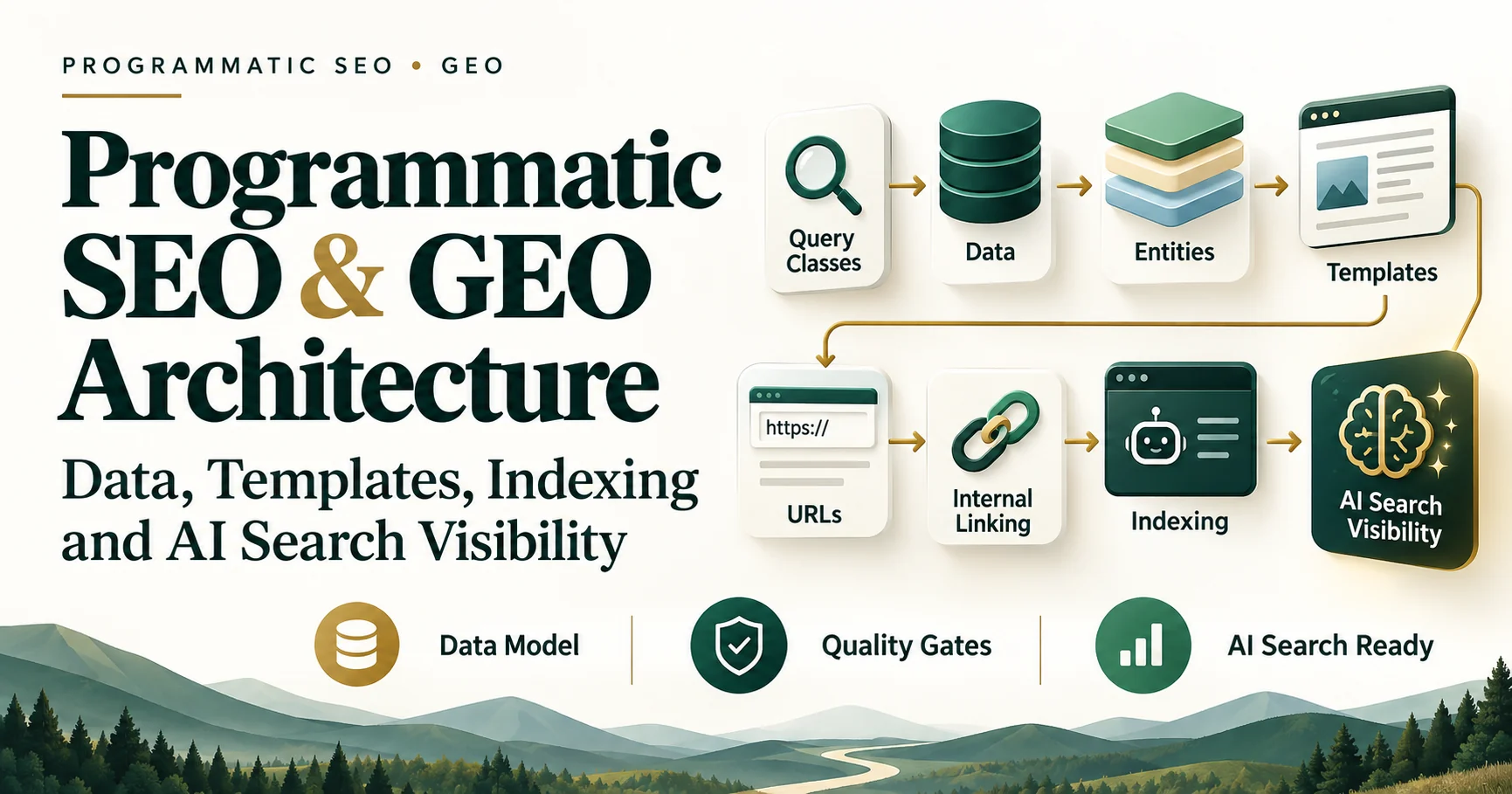
Programmatic SEO architecture is the system that connects scalable search demand with structured data, entities, page types, templates, URLs, internal links, crawl and indexing controls, structured data, and measurement. GEO requirements should strengthen how those pages represent facts and entities—not simply increase the number of generated URLs.
- Start with repeatable search tasks, not a database and a page generator.
- Define the data model, page types, quality gates and internal-link graph before scaling.
- Make GEO part of the information architecture by improving entity clarity, evidence, direct answers and machine-readable consistency.
Programmatic SEO becomes risky when “we can generate 50,000 pages” becomes the strategy. The technical ability to create URLs at scale is not the difficult part. The difficult part is deciding which URLs deserve to exist, what unique value each page must provide, how Google should discover and index them, and how those pages remain useful when hundreds or thousands of them share the same template. Adding GEO to that architecture does not change this basic principle.
You do not need a second mass-production system for AI search. You need the same scalable page system to represent entities, facts, relationships and evidence clearly enough that both traditional search engines and AI-driven retrieval systems can understand what each page contributes.
What Is Programmatic SEO Architecture?
Programmatic SEO architecture is the system connecting:
query classes → data → entities → page types → templates → URLs → internal links → crawl/index controls → measurement
That is very different from:
keyword list → AI-generated copy → publish
A scalable architecture determines:
- which search patterns deserve dedicated URLs;
- what data is required to support those URLs;
- which entities and relationships drive the pages;
- how many page types are actually necessary;
- how templates change according to intent;
- which URLs are indexable;
- how pages connect through internal links;
- how duplicate or low-value pages are prevented;
- how performance is measured by template and cohort.
The architecture should be designed before the content-generation pipeline.
Start With Query Classes, Not Individual Keywords
Programmatic SEO works best when search demand can be expressed as repeatable user tasks. Examples include:
[product] price[product] alternatives[product A] vs [product B][service] in [location][category] under [price][entity] statistics[integration A] + [integration B]
The important question is not whether you can generate the URL. It is whether the query pattern represents a distinct and useful search task. For example, thousands of city combinations do not automatically justify thousands of location pages. Each page needs enough local or entity-specific information to answer something meaningfully different. A useful query-class definition should document:
- search intent;
- expected user task;
- page type;
- required data;
- minimum unique information;
- internal-link relationships;
- indexability criteria.
Build the Data and Entity Model Before the Templates
Programmatic SEO is fundamentally a data architecture problem. Before designing the page, define the entities. For an ecommerce or price-comparison platform, these may include:
- Product
- Brand
- Category
- Merchant
- Offer
- Price
- Vintage
- Region
- Attribute
For a sports platform:
- Player
- Team
- Game
- League
- Season
- Statistic
- Market
- Prediction
For each entity, define:
- its unique identifier;
- attributes;
- relationships to other entities;
- canonical source of truth;
- update frequency;
- missing-data behavior;
- first-party vs third-party data;
- which facts can actually create unique page value.
This matters because a weak data model eventually becomes a weak template. If 90% of generated pages contain the same generic text and only one variable changes, the architecture does not have enough informational depth.
Define Page Types Before Building Templates
One database can support several search intents. That does not mean every combination should use the same page. A marketplace, for example, might need separate page types for:
- individual entity pages;
- comparison pages;
- category pages;
- location pages;
- price pages;
- statistics pages;
- recommendation pages.
Each page type should own a clearly defined task. A template contract should specify:
- target query class;
- mandatory data;
- optional or conditional modules;
- title logic;
- H1 logic;
- primary answer block;
- tables or comparison components;
- structured-data type;
- internal-link rules;
- canonical rules;
- indexability requirements;
- empty-state behavior;
- fallback behavior.
This is where Programmatic SEO becomes an engineering system rather than a publishing trick.
Design URL and Information Architecture Together
Generated URLs need a logical home in the site. A scalable structure commonly includes:
Hub → category/subcategory → programmatic leaf page
The exact hierarchy depends on the dataset and user journey, but the principle is consistent: important pages should exist within a discoverable architecture rather than as isolated URLs. Review:
- stable URL patterns;
- category layers;
- parent-child relationships;
- breadcrumb structure;
- crawl depth;
- filter parameters;
- faceted-navigation rules;
- canonical patterns.
Do not design the URL taxonomy separately from the information architecture. A clean URL is not useful if the page is still effectively orphaned.
Build Internal Linking Into the Template System
At programmatic scale, internal linking cannot be an editorial afterthought. The rules should be part of the page-generation system. A useful structure may include:
Hub → category → programmatic page
Programmatic page → parent hub
Programmatic page → contextually related entities/pages
For example, a wine page could link to:
- its producer;
- region;
- grape variety;
- comparable wines;
- current merchant offers;
- price-range pages.
A sports-player page could link to:
- team;
- league;
- season statistics;
- related players;
- relevant game data.
This creates a navigable graph rather than thousands of sitemap-only pages. Once the inventory grows, periodically run an internal linking audit to find orphan pages, excessive crawl depth and weakly supported page groups.
Decide Which Programmatic Pages Are Eligible for Indexing
Not every generated page should be indexable. This is one of the most important distinctions between controlled Programmatic SEO and indiscriminate URL generation. Define automated quality gates before a URL becomes indexable. A page may need to satisfy conditions such as:
- validated search intent;
- sufficient underlying data;
- meaningful unique value;
- HTTP 200;
- valid canonical;
- no contradictory robots directives;
- required modules populated;
- meaningful internal links;
- acceptable similarity to related pages;
- sufficiently fresh data.
For example, a [wine] price template with no current merchant prices should not necessarily produce an indexable page simply because the entity exists in the database. The generation rule and the indexing rule do not have to be identical. That distinction is essential at scale. For deeper diagnosis of these controls, see the website indexability audit.
Prevent Thin and Near-Duplicate Page Inventories
Template reuse is expected in Programmatic SEO. Near-identical informational value is not. Ask what meaningfully changes from URL to URL:
- facts;
- entities;
- comparison set;
- pricing;
- statistics;
- recommendations;
- relationships;
- local context;
- availability;
- analysis.
Changing only a city name or product variable may not create enough independent value. The architecture should define a minimum content/data threshold before publishing or indexing. This is also why quality gates belong in the system rather than in a manual cleanup project six months later.
Design XML Sitemaps and Canonicals for Scale
Large URL inventories should be segmented logically. You may separate XML sitemaps by:
- page type;
- entity type;
- language;
- category;
- launch cohort;
- data state.
Only preferred indexable URLs should normally appear in the sitemap. Canonicals should be generated from the same URL rules that define the page inventory. Avoid situations where:
- the generator creates one URL;
- internal links use another;
- the sitemap lists another;
- the canonical points somewhere else.
At scale, small rule inconsistencies become thousands of inconsistent URLs.
Generate Structured Data From the Same Entity Model
Structured data should not be bolted onto Programmatic SEO after the pages are generated. The same entity and attribute model used to build the visible page should also drive JSON-LD. Depending on the page type, relevant schema may include:
- Product
- ProductGroup
- Offer
- SoftwareApplication
- JobPosting
- LocalBusiness
- BreadcrumbList
- Dataset
- Article
The schema should reflect visible, accurate page information. Do not output a schema type merely because the template technically can. At scale, template-level schema problems can affect thousands of URLs. A schema markup audit should therefore be part of launch QA.
Add the GEO and AI Search Layer
GEO should not create a second page-generation strategy. Instead, it should influence how programmatic templates represent information. Useful GEO-oriented requirements include:
- clearly defined entities;
- explicit relationships;
- canonical facts;
- concise direct-answer sections;
- unique first-party data;
- useful tables and comparisons;
- visible evidence;
- source fields where appropriate;
- consistent terminology;
- crawlable HTML;
- structured data aligned with visible content;
- predictable freshness logic.
This makes the page easier to interpret and retrieve. For example, rather than creating a separate page for every possible AI fan-out question about a product, build the core product page so it contains structured, reusable answers about price, specifications, alternatives, availability, comparisons and provenance.
Programmatic SEO scales the page system. GEO improves the way that system expresses entities, facts, evidence and answerable information.
Measure Performance by Template and Cohort
Do not evaluate a 50,000-page Programmatic SEO system one URL at a time. Track cohorts. Useful metrics include:
- generated URLs;
- indexable URLs;
- sitemap-submitted URLs;
- crawled URLs;
- indexed URLs;
- pages receiving impressions;
- query coverage;
- clicks;
- conversions;
- page type;
- entity type;
- launch cohort;
- canonical consolidation;
- cannibalization;
- AI mentions or citations where they can be measured reliably.
For example:
> Template A: 12,000 generated → 9,500 indexable → 7,600 indexed → 5,400 receiving impressions.
That tells you far more than inspecting ten random pages.
When Should You Not Scale?
Do not scale yet when:
- the query classes are unvalidated;
- the data is too sparse;
- most generated pages would look almost identical;
- internal linking has not been designed;
- you cannot define an indexing rule;
- the existing test cohort is poorly indexed;
- data freshness cannot be maintained;
- the template does not answer a distinct user task;
- measurement is not in place.
A smaller useful inventory is usually better than a massive inventory that has to be deindexed and consolidated later.
Final Thoughts
Programmatic SEO architecture should be designed as a search system, not a publishing shortcut. Start with repeatable user tasks. Build the data and entity model. Define page types and template contracts. Design URL and internal-link architecture. Establish quality gates before indexing. Generate schema from the same source data. Then add the GEO layer by making entities, facts, relationships and evidence clearer. The question is not:
How many pages can we generate?
It is:
How many useful, technically consistent and independently valuable search experiences can the data genuinely support?
Put the architecture into practice
Review the sports data platform case study or discuss your platform through the Programmatic SEO and GEO architecture audit service.
For the eligibility workflow, see Programmatic SEO indexing quality gates.
Template contract example
An entity statistics page needs a stable entity ID, the relevant season, a source timestamp, a populated statistics table and a defined comparison context. Its preferred URL, title and H1 should come from the same ownership rules. Missing required data should trigger a documented fallback before sitemap inclusion. This is an illustrative contract, not a rule verified for the case-study platform.
Sources: Google AI search eligibility guidance and Google scaled content abuse policy.
Frequently Asked Questions
Is Programmatic SEO just creating landing pages from a database?
No. A serious Programmatic SEO system includes query validation, data modeling, page-type design, template rules, URL architecture, internal linking, index controls, structured data and measurement.
Should every entity in the database get an indexable page?
No. The entity can exist in the system without automatically qualifying for an indexable search page.
How does GEO change Programmatic SEO?
GEO should influence entity clarity, fact representation, evidence, direct-answer modules, structured data and freshness. It should not justify generating more URLs merely to target AI-query variations.
Do Programmatic SEO pages need unique text?
They need unique value, which can come from data, comparisons, relationships, statistics, availability, analysis or other page-specific information—not simply rewritten boilerplate.
How many programmatic pages can a site safely publish?
There is no universal safe number. The relevant questions are whether the pages provide useful independent value, can be crawled efficiently, satisfy quality gates and can be maintained.