Website Crawlability Audit
Audit website crawlability to find robots.txt blocks, server failures, orphan URLs, crawl traps, weak crawl paths, and other issues that prevent Googlebot from reaching important pages.
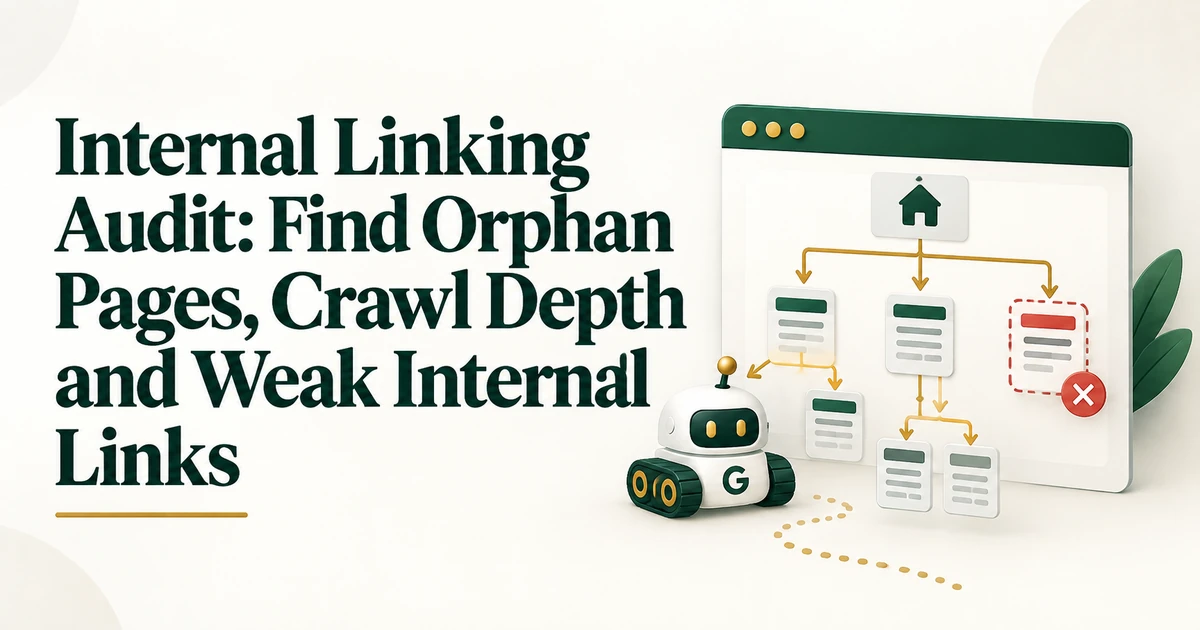
Read the guide →An internal linking audit checks whether priority pages are discoverable, reasonably close to important hubs, and supported by relevant contextual links. Find orphan URLs, excessive click depth, weak inlinks, broken paths, redirected links, and unclear anchor context.
Internal links are both navigation and infrastructure. They help users move through a site, help crawlers discover URLs, and help communicate how pages relate to each other.
An internal linking audit should therefore focus on whether important pages are reachable and supported - not on creating the largest possible number of links.
An internal linking audit reviews inlinks, outlinks, click depth, anchor text, navigation, breadcrumbs, contextual links, and broken or redirected paths across the site. The goal is to find priority URLs that are orphaned, buried, weakly linked, or connected through inefficient paths. For a focused next step, review find and fix Technical SEO issues.
Compare crawler data with XML sitemaps, analytics landing pages, CMS exports, or known URL inventories. URLs that exist in those sources but cannot be reached through a standard crawl may be orphaned. Not every orphan page needs a link; start with pages that have a clear search or business purpose. For a focused next step, review website indexability audit.
Review how many clicks separate priority pages from the homepage or their logical hub. High click depth is not automatically bad, but commercially important pages buried several layers deep deserve review. Look for duplicate category layers, unnecessary archives, weak hubs, or navigation that depends on filters rather than crawlable links.
Count internal inlinks, but interpret them in context. Ten links from irrelevant footer templates are not necessarily stronger than three relevant links from authoritative hub pages. Prioritize pages important for revenue, leads, or strategic topics but receiving little contextual support.
Anchor text should help users understand the destination. Review generic anchors, repeated exact-match anchors, and links placed in unrelated contexts. Use natural descriptive anchors that clarify topic relationships.
Crawl internal links and identify 4xx targets, redirecting URLs, chains, and links to old protocol or hostname versions. Update internal links to final 200 destinations where practical. For deeper redirect diagnosis, use the redirect audit.
Global navigation can strongly influence discoverability, but it should not be overloaded. Check whether primary sections are represented clearly and whether breadcrumbs reflect the site's real hierarchy. Footer links should support useful navigation rather than become a dumping ground for every SEO target.
Create a priority list based on business value, organic opportunity, crawl depth, existing inlinks, and indexing status. A high-value orphan service page should be addressed before a low-value archive. When crawler access itself is uncertain, pair this work with a website crawlability audit.
After implementation, recrawl the site and confirm that formerly orphaned or weakly linked URLs are now reachable through the intended paths. Check that new links point directly to final canonical URLs and do not create unnecessary redirect hops.
A strong internal linking audit gives priority pages clear crawl paths and meaningful contextual support. Focus on orphan pages, depth, weak inlinks, broken paths, and final canonical destinations rather than link volume alone.
There is no universal number. The right amount depends on page purpose, site architecture, and contextual relevance.
No. Crawl depth is a structural measurement, not a ranking score. It becomes useful when it reveals that important pages are unnecessarily difficult to reach.
No. Link where the relationship helps users and clarifies architecture. Fully connected meshes can become noisy and dilute topical structure.