A Practical Technical SEO Audit Checklist
A structured process for auditing crawlability, indexability, architecture, rendering, performance and validation.
Read the article →A technical SEO expert identifies, prioritizes, implements and validates website changes that improve how search engines crawl, render, index and understand important pages without treating every audit warning as equally important.

A technical SEO expert is an SEO professional who improves a website’s technical infrastructure so search engines can crawl, render, index, understand, and rank important pages correctly. Their work includes crawlability, indexability, redirects, canonical tags, site architecture, Core Web Vitals, JavaScript SEO, structured data, migrations, implementation support, and post-fix validation.
Technical SEO does not guarantee rankings, indexing, traffic, or AI citations by itself. Its purpose is to remove technical barriers and make important pages easier for search systems to access, process, and understand.
A website can appear completely normal to visitors while quietly sending search engines through broken redirects, conflicting canonical tags, inaccessible JavaScript or instructions not to index its most important pages.
Technical problems are not always visible from the front end. They often become apparent only through crawler data, Google Search Console evidence, rendered HTML, server responses and URL-level testing. Audit tools can identify many of these conditions, although they are considerably better at producing warnings than deciding what the business should fix first.
A technical SEO expert investigates how a website is discovered, crawled, rendered, indexed and interpreted by search systems. The expert then separates genuine problems from normal platform behaviour, prioritizes the work and confirms whether completed changes produced the intended technical result.
| Question | Direct Answer |
|---|---|
| What is a technical SEO expert? | A technical SEO expert improves the technical conditions that affect crawling, rendering, indexing, website architecture, performance, and search visibility. |
| What does a technical SEO expert fix? | They diagnose and fix issues with crawlability, indexability, redirects, canonical tags, XML sitemaps, internal links, JavaScript rendering, Core Web Vitals, structured data, and migrations. |
| When do you need one? | You may need one when important pages are not indexed, traffic drops after a technical change, a migration is planned, developers need SEO requirements, or audit tools show problems that need proper diagnosis. |
| Is a technical SEO expert the same as a developer? | No. A developer builds and maintains the website. A technical SEO expert evaluates how the website’s implementation affects search-engine crawling, indexing, rendering, and interpretation. |
| Is technical SEO only about audits? | No. Useful technical SEO includes evidence collection, diagnosis, prioritization, implementation support, and validation after fixes are completed. |
A technical SEO expert is an SEO professional who specializes in the technical conditions that affect how search engines access, process and understand a website.
The work commonly covers:
The objective is not simply to remove every warning from an audit tool. The objective is to ensure that important pages are technically accessible, send consistent signals and can be processed as intended .
Technical SEO supports search visibility, but it does not guarantee indexing, rankings, traffic or inclusion in an AI-generated answer. Content relevance, quality, competition, authority and user demand still matter.
Technical SEO focuses on whether search systems can access, process, and understand a website correctly. It is different from content SEO or general on-page SEO because the main problem is often not the words on the page, but the technical conditions around the page.
| Area | Technical SEO | On-page SEO | Content SEO |
|---|---|---|---|
| Main focus | Crawling, indexing, rendering, architecture, performance, structured data, redirects, canonicals, and technical signals. | Titles, headings, internal links, page relevance, metadata, and content structure. | Search intent, topical depth, content quality, examples, originality, and usefulness. |
| Main question | Can search systems access, process, and understand the page correctly? | Is the page clearly optimized for the target query? | Does the page satisfy the user’s need better than competing content? |
| Typical work | Robots.txt, noindex, canonical tags, XML sitemaps, Core Web Vitals, JavaScript SEO, schema, redirect mapping. | Title tags, headings, URLs, internal links, image alt text, content formatting. | Article planning, topic coverage, examples, FAQs, expert insight, and content updates. |
| Common owner | Technical SEO specialist, SEO consultant, and developer support. | SEO specialist or content SEO specialist. | Content strategist, writer, editor, and SEO specialist. |
A strong SEO strategy usually needs all three. Technical SEO removes access and processing barriers, on-page SEO clarifies relevance, and content SEO helps the page deserve visibility.
Watch the short version: What Does a Technical SEO Expert Do? summarizes the evidence, diagnosis, prioritization, implementation and validation workflow.
A strong Technical SEO engagement normally includes four connected stages: evidence collection, diagnosis, implementation and validation.
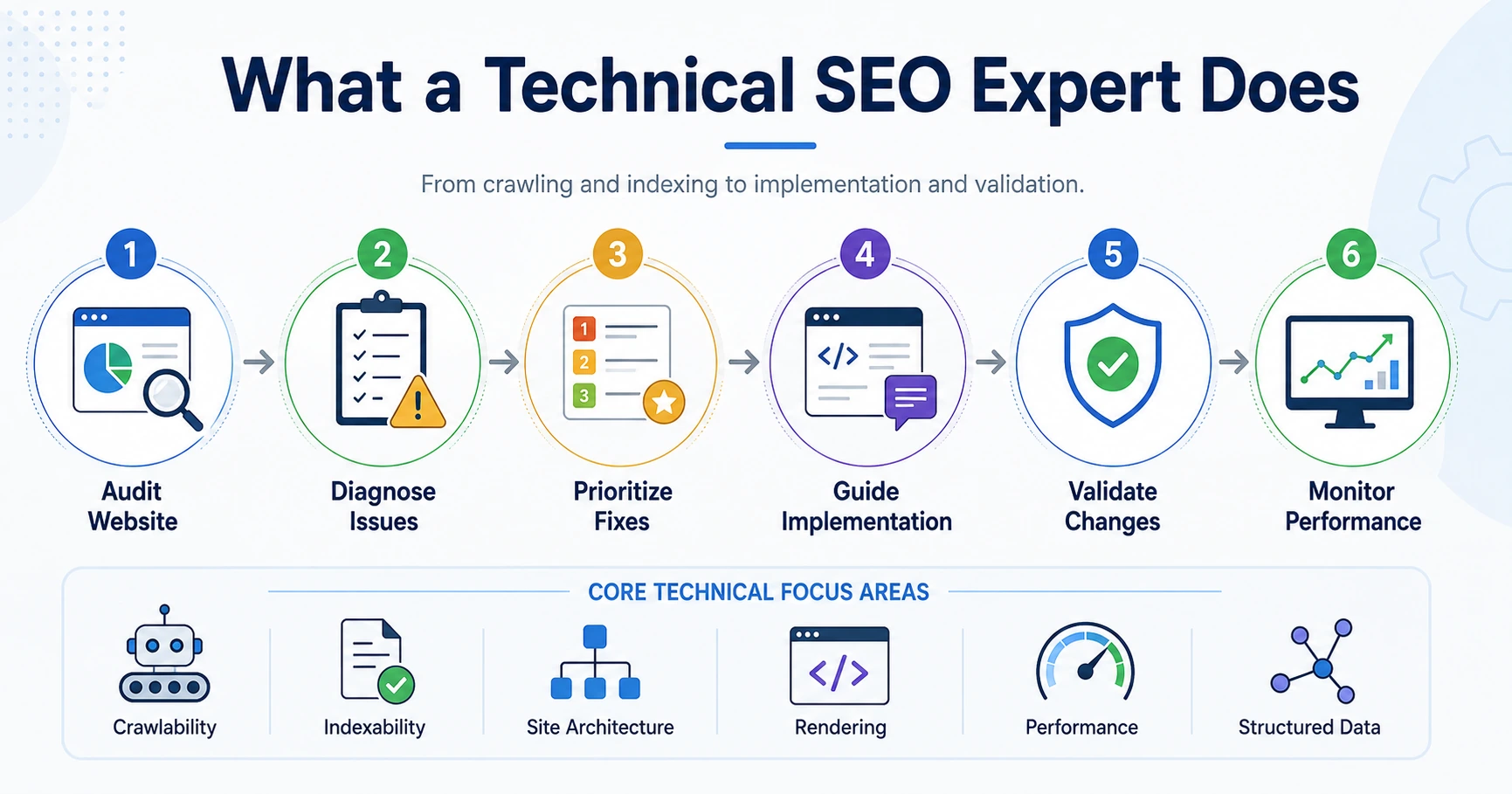
The expert begins by understanding the website, platform, business priorities and known problems.
Evidence may come from:
The audit should focus first on business-critical pages, important templates and known areas of concern. A minor warning on an obsolete URL is not automatically as important as a site-wide directive affecting every service page.
A structured technical SEO audit checklist helps ensure that crawlability, indexing, architecture, rendering, performance and validation are reviewed in a logical order.
Tools report technical conditions. They do not always establish whether those conditions are incorrect or commercially important.
For example:
A Technical SEO expert validates the finding, identifies its cause and determines which URLs or templates are affected.
The recommendation should then consider:
This prevents a website team from spending several days correcting cosmetic warnings while an important section remains blocked or incorrectly canonicalized.
Some specialists provide audit reports only. Others implement changes directly or work with developers, designers and content teams.
Direct implementation may include:
When developers need to complete the work, the expert should provide more than “fix the canonical tags.”
Useful developer instructions normally include:
Validation is part of the implementation.
After a fix, the Technical SEO expert should recrawl or retest the affected area and confirm that the original condition changed as intended.
Depending on the issue, this may include checking:
A completed development ticket is not the same as a validated SEO fix. The code may have been deployed successfully while the search-related condition remains unchanged.
Get a focused SEO review that identifies the issues, missed opportunities, and priority fixes.
Technical SEO work often becomes easier to understand through examples. Common examples include:
A fix is not complete just because a developer ticket is closed. The affected URL or template should be retested to confirm that the search-related condition changed as expected.
A strong expert page should also connect to platform and proof resources. Common project patterns include WordPress technical SEO problems, Shopify technical SEO issues, website migration SEO support, and canonical and indexing problems. For implementation evidence, see the WordPress technical SEO case study and the Shopify indexing audit case study.
The precise scope depends on the website, but most Technical SEO work falls into several recognizable groups.
Search engines must first discover and request a URL before they can process its content.
A specialist may investigate:
robots.txt
restrictions
A crawlable page is not automatically indexable, and an indexable page is not guaranteed to be selected for indexing.
Common areas include:
noindex
directives
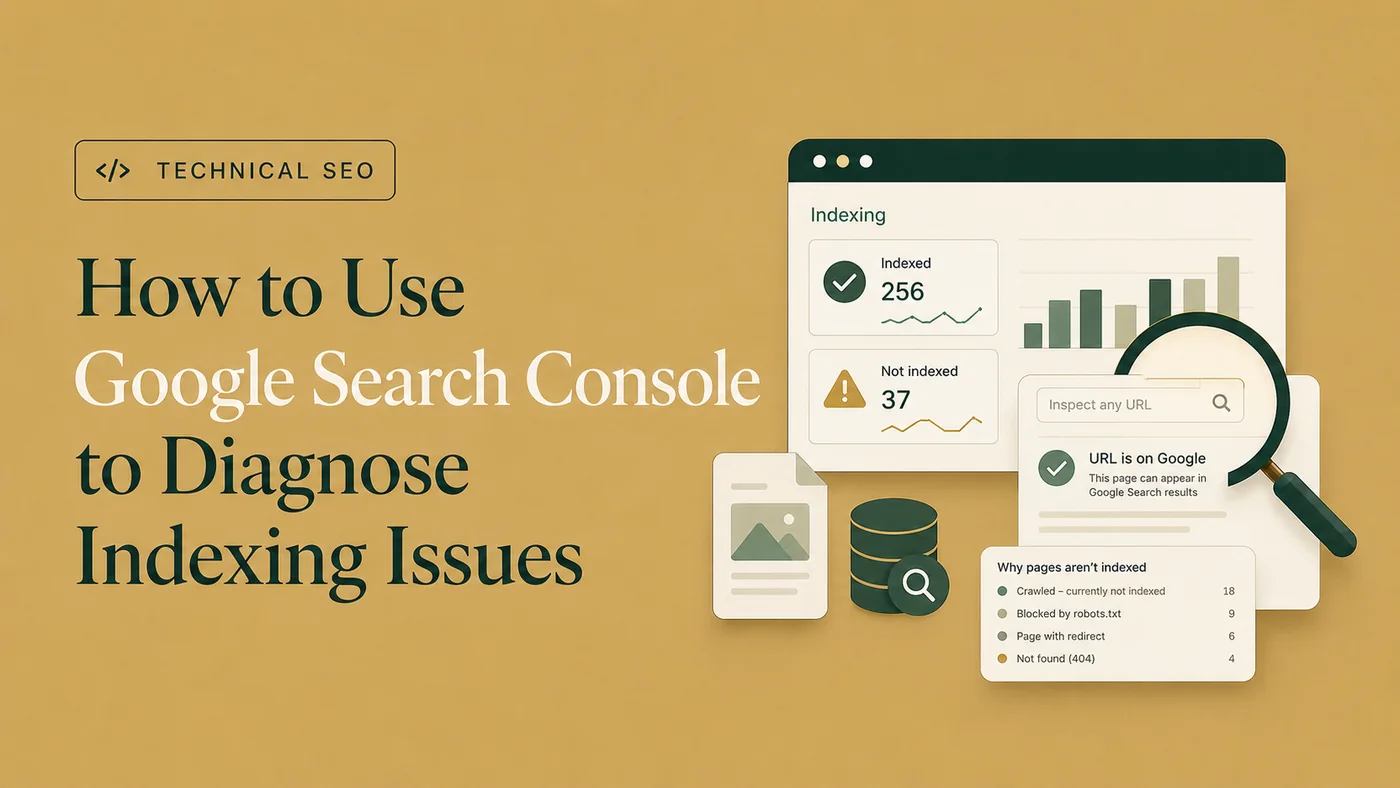
The Page Indexing report can show broader patterns, while URL Inspection provides evidence for an individual URL. A specialist can use both to diagnose indexing issues in Google Search Console instead of treating every excluded URL as an error.
Website structure affects how users and search engines move between related pages.
Technical work may involve:
JavaScript-heavy websites can create differences between what users see and what crawlers can access in rendered HTML.
A specialist may investigate:
Performance should be evaluated with both diagnostic tests and real-user field data where available. A single PageSpeed score is evidence, not a complete diagnosis.
Structured data can help search systems understand entities and page content and can make pages eligible for supported rich-result features.
Technical work may cover:
Valid markup creates eligibility, not a guarantee that a rich result will appear.
A Technical SEO expert is particularly valuable during:
Migration work may involve URL inventories, redirect mapping, canonical checks, internal-link updates, sitemap changes, pre-launch testing and post-launch monitoring.
For a wider diagnostic framework, see how to find and fix technical SEO issues without assuming that every crawler warning needs remediation.
Most technical SEO work falls into five main types.
Crawlability work focuses on whether search engines can discover and request important URLs. This includes internal links, XML sitemaps, robots.txt, crawl depth, orphan pages, broken links, server responses, redirects, and URL structure.
Indexability work focuses on whether a page is eligible and suitable for indexing. This includes noindex directives, canonical tags, duplicate URLs, parameterized URLs, sitemap consistency, Google-selected canonical differences, and conflicting technical signals.
Rendering work focuses on whether important content and links are available in the HTML that search systems can process. This is especially important for JavaScript-heavy websites, client-side rendering, dynamic content, faceted navigation, and mobile content delivery.
Architecture work focuses on how pages are organized, linked, and prioritized within the website. A strong structure helps users and search engines understand which pages are important and how related pages connect.
Performance and structured-data work helps search systems understand and evaluate pages more reliably. This includes Core Web Vitals, page speed diagnostics, schema markup, entity clarity, rich-result eligibility, and post-fix validation.
The terms Technical SEO expert and Technical SEO specialist are generally used interchangeably.
A general SEO specialist may work across:
A Technical SEO specialist has a narrower and usually deeper focus on website infrastructure, crawling, indexing, rendering, architecture, performance, structured data and implementation.
The roles can overlap. A general SEO specialist may understand Technical SEO well, while a Technical SEO expert may also contribute to content structure, internal linking and search strategy.
The important distinction is not the job title. It is whether the person can correctly diagnose the website’s technical conditions, prioritize the work and validate the outcome.
No, although the roles frequently work together.
A developer builds and maintains the website’s functionality. A Technical SEO expert evaluates how the website’s implementation affects search-engine access, processing and interpretation.
For example, a developer may know how to create a redirect rule. The SEO specialist determines:
Developers are not expected to make every search-strategy decision, just as Technical SEO specialists are not substitutes for experienced software engineers.
The best results usually come from clear collaboration between SEO, development, content and business stakeholders.
Specialist support becomes useful when the website has a material problem, complex platform behaviour or a change with significant search risk.
Common situations include:
You may not need a specialist for every small website change. A technically simple website with no material search problem may only require periodic review.
The need becomes stronger when an error can affect many pages, valuable templates, revenue-generating sections or an irreversible launch.
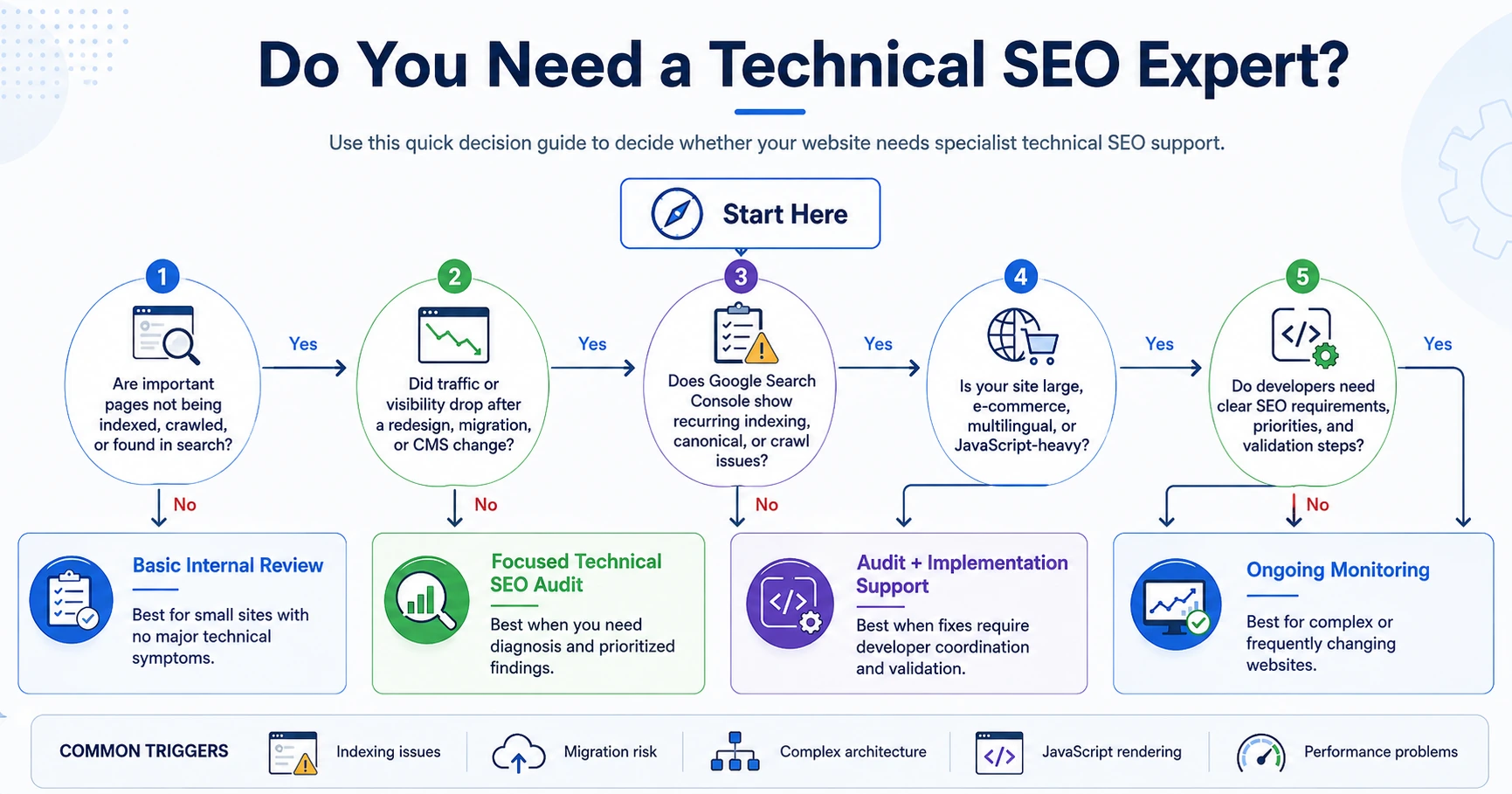
Technical SEO services can be delivered at several levels.
The specialist reviews the website and provides findings and recommendations.
This can be suitable when an experienced internal development team will handle implementation.
The specialist provides:
This format is useful when developers need precise instructions rather than a general SEO report.
The expert completes selected fixes directly where platform access, technical ability and project scope allow.
This may be appropriate for WordPress, Elementor, Shopify or configuration-level corrections.
Technical SEO can also be ongoing when the website:
A useful engagement should define what will be audited, who will implement each change, how recommendations will be prioritized and how the fixes will be validated.
You can review the available Technical SEO audit, implementation and indexing services when the website requires a defined investigation or fixing scope.
Technical SEO can support AI search visibility, but it does not guarantee inclusion in AI Overviews, AI Mode, ChatGPT Search, Perplexity, Gemini, or other AI-generated answers. For a focused next step, review AI Search Optimization services.
AI-powered search systems still need accessible, understandable, and retrievable source pages. If a page cannot be crawled, rendered, indexed, or interpreted correctly, it is less likely to perform well across both traditional search and AI-influenced search surfaces.
Technical SEO can help by improving crawler access, indexable text content, internal links, rendered HTML, canonical consistency, page performance, structured data accuracy, entity clarity, mobile usability, and crawl and indexing validation.
However, technical SEO is only one part of AI visibility. AI search systems also consider relevance, usefulness, authority, originality, topical coverage, citations, brand/entity signals, and whether the content directly answers the user’s question.
The goal is not to “force” AI systems to cite a page. The goal is to make the page technically accessible, semantically clear, and useful enough to be considered as a reliable source.
Evaluate the specialist’s diagnostic process rather than relying only on tool names or promises.
Look for someone who can demonstrate:
The specialist should validate findings through multiple evidence sources rather than copying an automated export.
Recommendations should reflect valuable pages, affected templates, likely impact, implementation effort and risk.
The expert should explain how a recommendation will be applied and what dependencies or side effects must be considered.
Technical findings should be understandable to website owners and actionable for developers.
The scope should explain how completed changes will be checked.
Experience with your CMS, framework, website type or migration scenario can reduce implementation risk.
Case studies, work samples, implementation documentation and client feedback are more useful than unsupported claims.
For example, a Technical SEO audit and developer-ready fixing roadmap demonstrates how findings can be converted into URL-level evidence, priorities and implementation specifications.
Be cautious of guarantees. No legitimate specialist can guarantee rankings, indexing, AI citations or a precise traffic result from technical work alone.
If you want to understand the role in more detail, these related guides explain each part of the decision process:
A Technical SEO expert audits, diagnoses, prioritizes, implements and validates website changes affecting crawling, rendering, indexing, architecture, performance and structured data.
Some experts provide audits and developer instructions, while others implement selected corrections directly. The engagement should clearly define which fixes the specialist will complete and which require a developer.
Common tools include Google Search Console, website crawlers, PageSpeed Insights, Lighthouse, browser developer tools, URL Inspection, the Rich Results Test, analytics platforms and server-log analyzers. The appropriate tools depend on the website and problem.
It can be either. A focused audit or migration may be a one-time engagement, while large, frequently changing or technically complex websites may require ongoing monitoring and implementation support.
Technical improvements can remove barriers and strengthen the signals search systems use to access and understand pages. They do not guarantee higher rankings because search visibility also depends on relevance, content quality, competition, authority and demand.
Technical SEO can be hard because it requires understanding how websites behave for search engines, not only how they look to users. The difficult parts are diagnosing the real cause of problems, prioritizing fixes, working with developers, and validating changes across crawling, indexing, rendering, redirects, canonicals, performance, and structured data. The learning path is covered in how to become a Technical SEO expert.
SEO can be a high-value skill, especially when it connects strategy with measurable business outcomes. Technical SEO can be particularly valuable because it deals with website infrastructure, indexing, migrations, performance, and implementation risks that can affect important pages, leads, revenue, and organic visibility.
A technical SEO expert’s earnings depend on country, experience, employment model, website complexity, and scope of responsibility. Senior technical SEO specialists, consultants, and freelancers who can diagnose indexing, migration, JavaScript, Core Web Vitals, and implementation issues usually command higher rates than entry-level general SEO roles.
The cost depends on the scope. A focused indexing review, technical SEO audit, migration review, Core Web Vitals diagnosis, and ongoing technical SEO support require different levels of work. Pricing should reflect the number of affected URLs, technical complexity, implementation responsibility, business risk, and validation requirements. For a detailed breakdown, see Technical SEO expert cost, pricing and scope.
SEO is evolving, not dead. Search is becoming more AI-assisted, but websites still need crawlable, indexable, useful, well-structured, and trustworthy content. Technical SEO remains important because search and AI systems still need accessible pages that can be discovered, rendered, understood, and evaluated.
AI can help with audits, summaries, pattern detection, and recommendations, but it does not fully replace technical SEO judgment. Websites still need human validation, prioritization, platform understanding, developer coordination, business context, and risk management, especially during migrations, indexing problems, and complex technical changes.
Technical SEO focuses on the technical conditions that affect crawling, rendering, indexing, architecture, performance, redirects, canonicals, and structured data. On-page SEO focuses more on page-level relevance signals such as titles, headings, content structure, internal links, search intent, and keyword alignment. Both support organic visibility.
You can handle basic technical SEO checks yourself, such as fixing simple broken links, reviewing obvious noindex issues, submitting sitemaps, or updating basic CMS settings. Specialist help is safer when the issue affects important pages, large URL sets, migrations, JavaScript rendering, canonical conflicts, redirects, or Search Console indexing problems.
Examples include fixing accidental noindex tags, correcting canonical conflicts, cleaning XML sitemaps, repairing redirect chains, improving internal links to orphan pages, diagnosing JavaScript rendering issues, validating structured data, improving Core Web Vitals, and testing fixes after implementation.
A technical SEO expert may use Google Search Console, Screaming Frog, Sitebulb, PageSpeed Insights, Lighthouse, Chrome DevTools, URL Inspection, Rich Results Test, analytics platforms, server-log tools, CMS data, rendered HTML, and manual URL-level testing. Tools provide evidence, but expert judgment is needed to decide what matters.
No. Audit tools are useful, but they often report conditions without explaining business impact or priority. A technical SEO expert separates real issues from normal platform behavior, identifies affected URLs or templates, prioritizes by risk and value, and validates whether fixes worked.
A Technical SEO expert does more than run a crawler and export the warnings.
The role is to determine whether important pages can be discovered, crawled, rendered, indexed and understood correctly; identify the conditions that genuinely interfere with those processes; and turn the evidence into prioritized, implementable work.
The right specialist should be able to explain:
That combination of diagnosis, prioritization, implementation awareness and validation is what separates useful Technical SEO work from another long spreadsheet of warnings.



Clear diagnosis, practical fixes, and excellent communication.
Verified Upwork feedback