For many Shopify teams, merchandising and SEO are managed as separate activities. Merchandising decides:
- Which products belong together
- Which collections should be promoted
- What appears in navigation
- Which seasonal campaigns go live
- How new products are launched
- What happens when products are discontinued
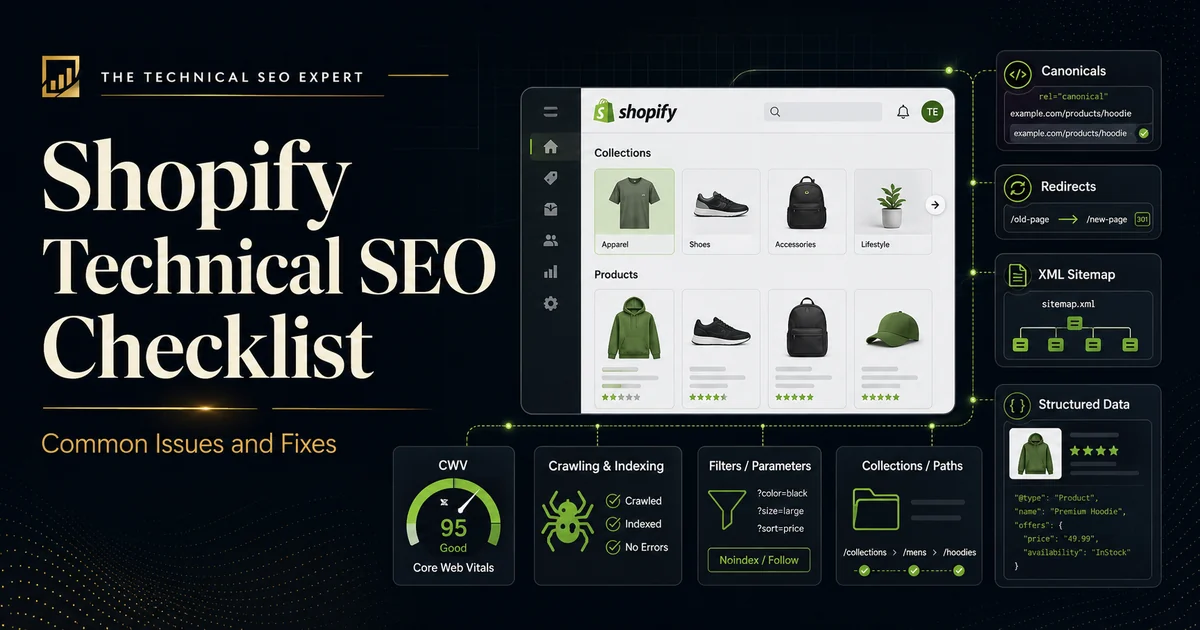
SEO is then expected to optimize whatever has already been created. That division looks reasonable operationally, but it can create problems. Many of the decisions that influence organic search visibility happen before anyone opens an SEO tool. Creating a new collection creates a new potential search landing page. Changing navigation changes which products and collections receive internal support. Removing a product changes an existing URL and potentially an existing source of traffic. Rebuilding a seasonal campaign every year may create a new page where an established one could have been reused. The broader Shopify Technical SEO guide covers the technical issues that can result from Shopify themes, apps, URLs, filters, canonicals and redirects. This article looks at the decision one step earlier: How do everyday merchandising choices affect SEO before they become technical problems?
Shopify SEO Starts With What the Store Chooses to Promote
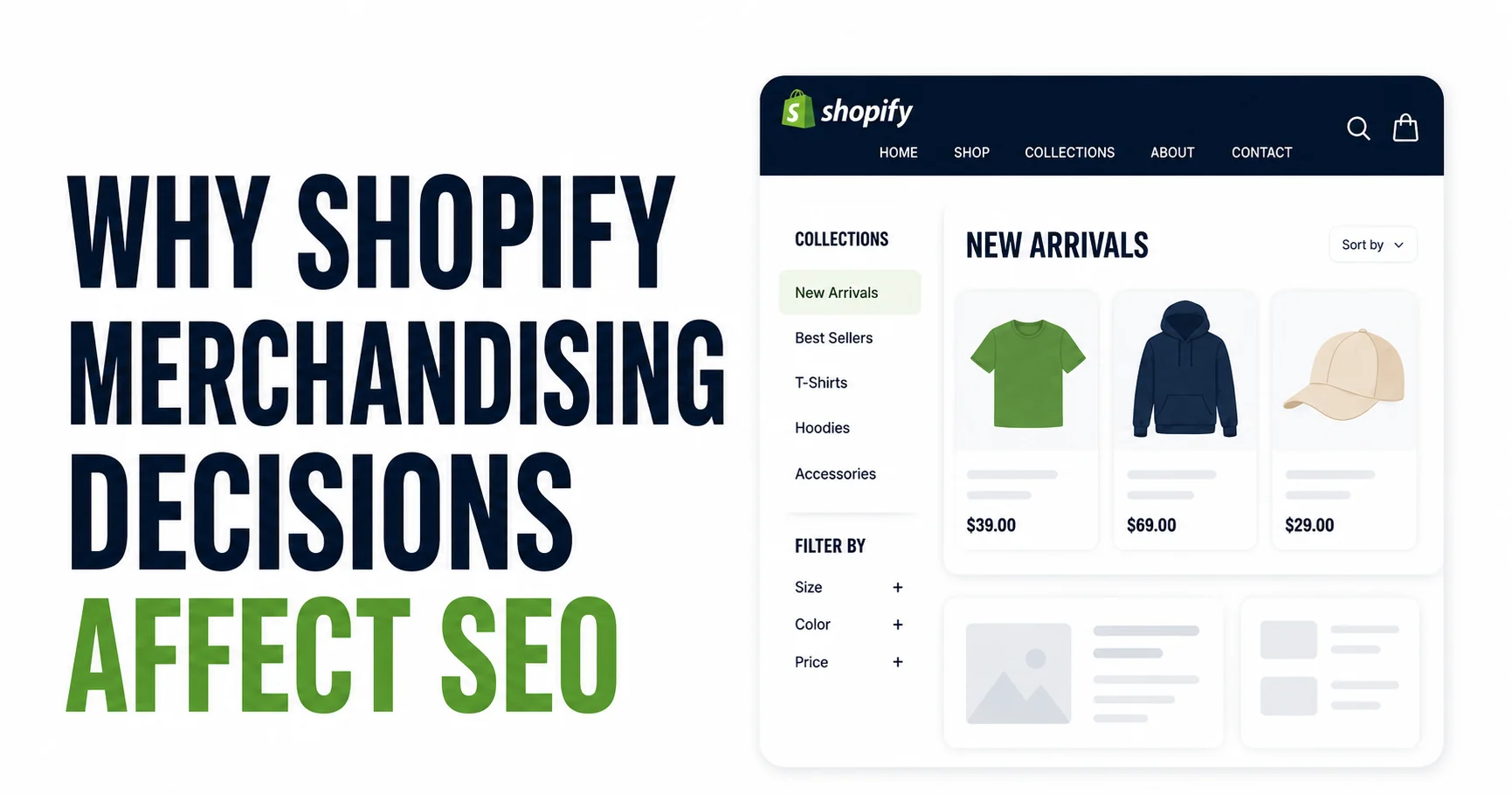
Search engines do not see a Shopify store as a product catalogue in the same way an internal merchandising team does. They see pages, links, relationships and signals. A product may belong to several collections. A collection may appear in the main navigation, in a seasonal promotion, deep inside another category, or nowhere except its direct URL. Two stores may sell exactly the same products while presenting completely different site structures. That matters because Shopify allows collections to function as standalone storefront pages, and those collections can be linked through store menus to help customers find groups of products. (Shopify Help Center) The merchandising decision:
“These products should be grouped together.”
can therefore become the SEO decision:
“This group deserves its own landing page and a defined place in the site architecture.”
Those are not always the same thing. A collection may be useful for merchandising without representing meaningful search demand. Conversely, a commercially important product category may deserve a permanent, optimized collection even when it is not currently receiving much promotional attention. The distinction requires marketing, merchandising and SEO to look at the same store from different perspectives.
1. Collection Strategy Is Also Search-Demand Strategy
Collections are one of the most important points where Shopify merchandising and SEO overlap. A merchandising team may create collections around:
- Product type
- Brand
- Gender
- Use case
- Material
- Season
- Promotion
- Customer segment
- Price range
- New arrivals
- Best sellers
But not every collection has the same search value. Consider the difference between: Men's Running Shoes and: This Week's Staff Picks Both may be useful storefront collections. The first potentially represents persistent commercial search demand. The second may primarily support browsing and merchandising. This is why collection creation should not automatically mean: new collection = new SEO landing page. Before creating an important permanent collection, marketers should ask:
- Does a meaningful customer need exist?
- Do people search for this category or concept?
- Is the intent commercially relevant?
- Is this genuinely different from an existing collection?
- Can the collection remain useful beyond one campaign?
- Where will it sit within the store architecture?
- Which products and content should support it?
Shopify also allows merchants to customize collection titles, descriptions and URL handles, reinforcing that collections are not merely backend product groupings—they can operate as customer-facing search landing pages. (Shopify Help Center) The strategic point is simple: Taxonomy should reflect customer demand, not only internal merchandising language.
2. Navigation Tells Customers—and Search Engines—What Matters
Changing a menu may feel like a UX or merchandising decision. It is also an SEO decision. Shopify menus can link directly to products, collections, pages and blog content. Shopify itself recommends thinking about how customers should find products and information when designing store navigation. (Shopify Help Center) That means the main navigation is effectively a statement about priority. If a high-value collection sits prominently in the store architecture, it receives a very different level of support from a collection that can only be reached through several clicks or an internal search. This becomes particularly important as stores grow. A small Shopify store may have: Shop → Men → Women → Accessories A larger retailer may need to decide whether customers navigate by:
- Product type
- Use case
- Brand
- Audience
- Sport
- Style
- Material
- Season
Those are merchandising decisions. But they also determine how the website organizes commercial demand. A marketer should therefore ask more than: “Does this navigation help customers browse?” Also ask: “Does this structure reinforce the categories and products we want to acquire customers through?” Good ecommerce architecture should support both.
3. Product Launches Need an Organic Search Plan Too
A Shopify product launch often revolves around:
Get help with the technical SEO issues holding your Shopify store back.
I review indexing, canonicals, collection and product templates, structured data, internal linking, and performance to turn Shopify SEO problems into clear technical actions.
- Paid social
- Paid search
- Influencers
- Homepage promotion
- Promotional banners
- Product feeds
Organic search may enter the discussion later. But a product page does not become strategically useful simply because it has been published. A launch should also determine:
- Which collection the product belongs to
- Which existing pages should link to it
- Whether the product targets existing search demand
- Whether another product already serves the same intent
- Whether supporting editorial content is useful
- What happens to the URL if the product sells out
- Whether the product is temporary or permanent
This becomes more important when stores launch products frequently. Publishing hundreds of products without deciding how they fit within the store's acquisition structure can create a large inventory of pages with very uneven organic support. The marketing question should therefore not only be: How do we promote the launch? It should also be: Where does this product belong after the launch campaign ends? That is the difference between a campaign asset and a durable organic asset.
4. Seasonal Campaign Pages Should Not Always Start From Zero
Black Friday. Christmas gifts. Summer sale. Back to school. Mother's Day. Holiday collections are normal parts of ecommerce merchandising. But marketing teams should decide whether a campaign represents: a temporary promotion or: a recurring demand category. If customers search for substantially the same concept every year, repeatedly creating a completely new structure may discard useful continuity. For example, there may be a strategic difference between creating:
/collections/black-friday-2026/
then:
/collections/black-friday-2027/
and maintaining a durable Black Friday destination whose products, copy and promotional details are refreshed each year. This does not mean every seasonal campaign should use an evergreen URL. It means the decision should be intentional. Ask:
- Does this search demand return every year?
- Does the existing page already have visibility or links?
- Can the content be updated without misleading users outside the campaign period?
- Is there a reason the old campaign needs to disappear?
- What should happen when the promotion ends?
These are marketing questions first. The redirects, URLs and indexing decisions come afterward.
5. Discontinued Products Are a Marketing Decision Before They Are a Redirect Decision
A product reaches the end of its lifecycle. What happens next? Some stores simply delete it. Others redirect everything to the homepage. Others leave unavailable products live indefinitely. None of these should be an automatic rule. A discontinued product page may still have:
- Organic traffic
- External links
- Brand demand
- Product comparisons
- Customer reviews
- Useful specifications
- Search demand
- A relevant replacement product
The correct action depends on what the page still does for the customer. If a close replacement exists, directing users toward that replacement may make sense. If the product may return, maintaining the page with clear availability information may be useful. If the product is permanently gone and no relevant alternative exists, removal may be appropriate. Shopify supports URL redirects specifically for situations such as deleted products, allowing an old URL to send customers to an appropriate replacement page. (Shopify Help Center) But the important decision happens before the redirect is created: Where should someone looking for this product go next? That is fundamentally a merchandising and customer-experience question. SEO implementation should follow that answer.
6. Promotional Landing Pages Can Become Organic Assets
Marketing teams routinely create pages for:
- Paid-search campaigns
- Influencer campaigns
- New product drops
- Email promotions
- Seasonal events
- Brand collaborations
- Special offers
Many of those pages are treated as disposable. Campaign launches. Traffic arrives. Campaign finishes. Page disappears. Sometimes that is entirely appropriate. But sometimes paid campaigns reveal something useful: real customer demand. A landing page created for paid acquisition may prove that customers respond strongly to a particular product category, use case or problem. At that point, marketing should ask: Does this concept deserve a permanent place in the organic acquisition strategy? A temporary landing page might evolve into:
- A permanent collection
- A buying guide
- A category page
- A comparison resource
- A use-case page
- Supporting editorial content
This is where paid and organic acquisition can inform each other rather than operating in separate planning systems. Campaign data can reveal demand. SEO can determine whether that demand deserves a durable search asset.
7. Filters Should Reflect Shopping Needs Without Becoming the Content Strategy
Filters are extremely useful in ecommerce. Customers may want to narrow products by:
- Size
- Colour
- Brand
- Price
- Availability
- Material
- Style
- Feature
From a merchandising perspective, these are customer-selection tools. But there is an important strategic distinction between: a useful filtering option and: a category that deserves to become a permanent search landing page. Suppose customers frequently want: Women's Waterproof Hiking Boots If that combination has clear demand and commercial importance, the store might benefit from a deliberate collection or landing-page strategy around it. That is very different from expecting every possible combination of colour, size, price and sorting option to become an acquisition page. Your parent Shopify Technical SEO article already covers the technical problems that unrestricted filtering can create, including large numbers of URL variations. (The Technical SEO Expert) For marketers, the more important principle is: Use merchandising data to identify valuable customer categories, then deliberately decide which deserve search visibility. Do not let the filtering system make that strategy automatically.
SEO Should Be Involved Before the Merchandising Decision Is Finished
This does not mean an SEO specialist needs to approve every product upload or navigation change. That would slow the business unnecessarily. It means there are certain decisions where SEO should be part of the planning process rather than brought in afterward. These include:
- Creating or restructuring major collections
- Renaming important categories
- Changing main navigation
- Launching large new product ranges
- Removing large numbers of products
- Reorganizing store taxonomy
- Replacing recurring seasonal pages
- Changing collection URLs
- Replatforming or redesigning the store
- Creating large numbers of new landing pages
The earlier SEO is involved, the more options the team has. After the change goes live, the conversation can become: “How do we fix the SEO consequences?” Before launch, the conversation can be: “How do we design this so it supports customers, merchandising and organic acquisition at the same time?” The second conversation is usually more useful.
A Simple Shopify Merchandising + SEO Framework
Before making a significant merchandising change, consider four questions.
1. Customer
Does this help customers find or understand products more easily?
2. Demand
Does the page, category or concept represent meaningful search or customer demand?
3. Architecture
Where should it sit within the permanent structure of the store?
4. Lifecycle
What happens to the page when the product, campaign or promotion changes? These four questions can prevent many SEO problems before they require technical fixes. They also keep the discussion at the right level. SEO should not dictate merchandising. Merchandising should not ignore search behavior. Both should support the same commercial objective: helping relevant customers discover the right products.
Frequently Asked Questions
Does Shopify merchandising affect SEO?
Yes. Merchandising decisions can influence which collections and products exist, how they are organized, which pages receive navigation and internal links, and what happens when products or campaigns change. These decisions can therefore affect organic search visibility.
Are Shopify collection pages important for SEO?
They can be particularly important when a collection represents meaningful commercial search demand. Collections can operate as dedicated storefront pages and can be linked directly through Shopify navigation. (Shopify Help Center)
Should every Shopify collection be optimized for SEO?
No. Some collections exist mainly for merchandising, promotions or temporary browsing needs. SEO priority should focus on collections with a meaningful search purpose and a clear role in the store architecture.
Should discontinued Shopify products be deleted?
Not automatically. Consider whether the product may return, still receives useful traffic, has a relevant replacement, or provides useful information. Shopify supports redirects from removed URLs when an appropriate destination exists. (Shopify Help Center)
Should seasonal Shopify pages be recreated every year?
Not automatically. If the underlying search demand recurs each year, maintaining and updating an established page may sometimes be more useful than creating a completely new destination. The decision should depend on the campaign, user experience and search purpose.
Should SEO control Shopify merchandising?
No. SEO should inform merchandising decisions where they affect organic acquisition, site architecture and page lifecycle. The goal is coordination between marketing, merchandising, development and SEO—not giving one discipline control over the others.
Final Thoughts
Shopify SEO does not begin with canonical tags, schema markup or crawl reports. Many important SEO decisions happen earlier. They happen when a marketing team decides: which collections should exist, which products should be promoted, how customers navigate the store, what happens to discontinued items, whether seasonal pages are reused, and which customer needs deserve permanent landing pages. Those are merchandising decisions. They are also decisions about the store's organic acquisition structure. A strong Shopify SEO strategy therefore does not wait for merchandising to finish and then try to optimize the result. It connects customer demand, merchandising priorities, site architecture and organic search before the decisions become fixed. For the technical side of that process—including Shopify URL patterns, indexing, canonicals, filters, redirects, performance and structured data—see the full Shopify Technical SEO checklist.