AI Citation Readiness: How to Make Your Pages Useful Sources
Build accessible, attributable source pages with clear evidence and realistic measurement—without promising that an external system will cite them.
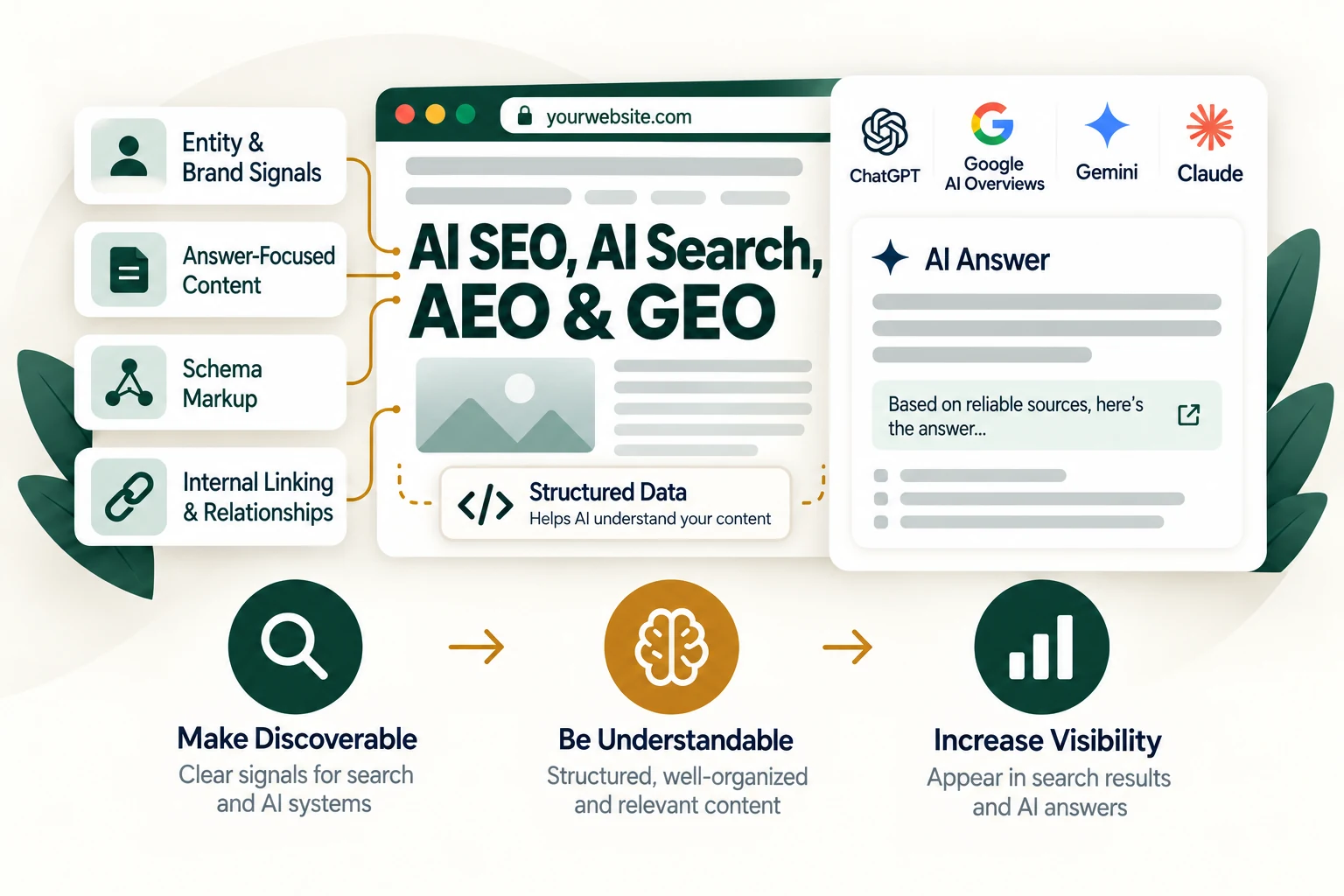
AI citation readiness means making a page accessible, understandable and useful as a source for a specific question.
- Confirm that the relevant crawler can reach readable, canonical HTML.
- Connect each important finding with its method, evidence and limitation.
- Measure mentions, citations, visits and enquiries as separate outcomes.
AI citation readiness combines technical access, clear authorship, relevant evidence and a page that explains its subject well. These foundations can help an external system evaluate the page, but the platform still decides whether to retrieve, mention or cite it. Google likewise explains that its generative search features use established search and indexing systems rather than requiring special “AI schema” or a dedicated AI text file.
What counts as a citation?
A citation is a clickable source URL used to support an answer. A brand mention names the business without necessarily linking to it. A recommendation explicitly presents the business or service as an option. A referral is a measurable visit, and an enquiry is a separate business action.
Illustrative example, not an observed result: an answer names Murat SEO but links only to a third-party publication. That is a mention, not an on-site citation. If the answer links to this guide as a supporting source, that run contains an on-site citation. Neither result proves that a visitor arrived or enquired.
Can the relevant system reach the page?
Start with delivery, not formatting tricks. Check the requested URL, HTTP status, robots.txt, robots meta and response headers, canonical destination, rendered main content and any security challenge. Follow internal links to confirm the page is discoverable from the site architecture. A response obtained with a copied user-agent proves only that synthetic request; verified crawler traffic and security-event logs are stronger evidence.
The website crawlability audit guide explains how to trace blocked paths, orphan pages and server failures. If a verified crawler is challenged, identify the named rule and scope the smallest correction rather than disabling security sitewide.
Search crawling, requested visits and training are separate
Providers document different crawler roles. OpenAI distinguishes OAI-SearchBot for search, ChatGPT-User for user-initiated visits and GPTBot for training. Anthropic similarly documents Claude-SearchBot, Claude-User and ClaudeBot. Perplexity documents PerplexityBot and Perplexity-User. Review the current provider documentation before changing policy: OpenAI crawlers, Anthropic crawlers, and Perplexity crawlers.
Allowing a search crawler does not authorize training, guarantee retrieval or mean a private retrieval API is used by general assistant search. Treat each control according to its documented purpose.
What can this page contribute that another source cannot?
Useful source pages add first-hand decisions, implementation artifacts or carefully bounded observations. A generic definition can be reproduced by many sites; a documented method for deciding page ownership, canonical behavior or acceptance criteria is more specific and reviewable.
For example, the programmatic SEO and GEO architecture case study documents a 1,075-row implementation matrix covering page-family ownership and developer guidance. The matrix establishes a delivered specification. It does not prove that every row was deployed or that the public performance snapshots were caused solely by that work.
Make the answer and its evidence understandable together
Keep the reasoning beside the claim. A practical pattern is:
- Finding: two URL families compete for the same service intent.
- Method: compare templates, canonicals, internal links and sitemap membership by page family.
- Evidence: list representative URLs and the implementation matrix that records ownership.
- Limitation: the audit specifies the target state; production rollout and later performance require separate validation.
Do not place the only explanation inside an image. Use visible text to explain what a screenshot or artifact establishes and what it cannot establish.
Connect author, service and proof
Readers should be able to identify the author, understand the relevant service and inspect related work. This guide is written by Murat, Technical SEO specialist. The AI Search Optimization service explains the commercial scope. Structured data can describe those real relationships, but schema does not force an external system to cite the page.
Readiness review
| Observation | Check | Interpretation | Next action |
|---|---|---|---|
| A verified crawler receives a challenge | Security event and matched rule | Access may be blocked before content evaluation | Prepare a narrow, verified correction |
| Important detail exists only in an image | Delivered HTML and accessible text | The evidence lacks readable context | Add a visible explanation and limitation |
| The page answers a broad term but not the decision | Question-to-page ownership | Accessible does not mean relevant | Add diagnostic criteria or a practical example |
| An unsupported metric is repeated | Original evidence and reporting window | The claim cannot be assessed reliably | Qualify, source or remove it |
| A fixed sample yields no citations | Access, relevance and competing sources | The finite sample observed zero citations | Report the denominator; do not generalize |
Measure what happens
Track access, mentions, recommendations, linked citations, measurable referrals and qualified enquiries separately. The guide to measuring AI search visibility, citations and referral visits provides a repeatable method. A source appearance is evidence of that answer’s source selection, not evidence of traffic or a qualified lead.
Need a source-page and access review?
Explore the AI Search Optimization service or describe the website, market and questions you need to answer. No citation, inclusion or lead volume is guaranteed.